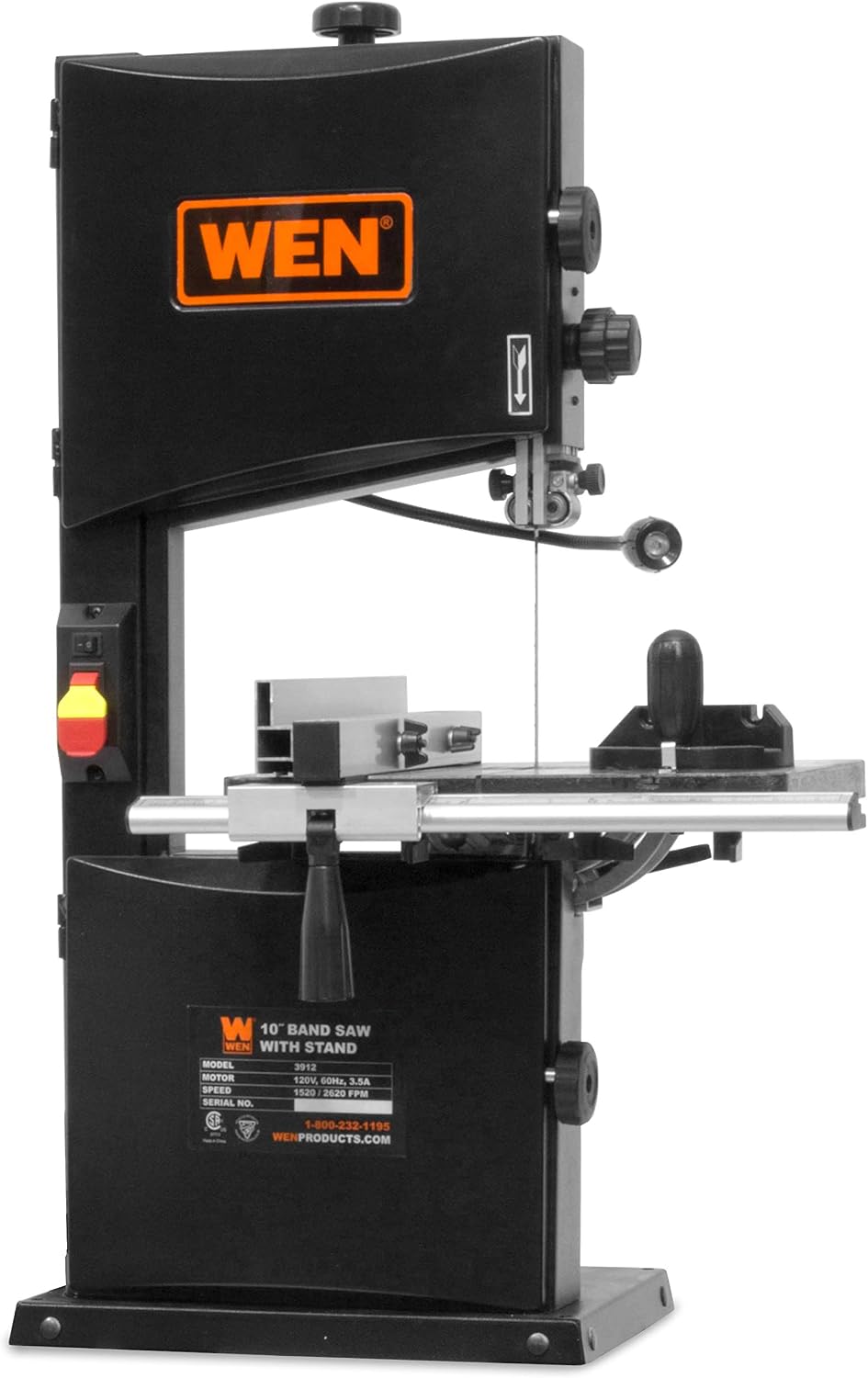
A bandsaw is a power saw that uses a continuous loop of toothed metal blade — picture a loop running between two wheels — to cut curves, resaw thick lumber into thinner slabs, and handle shapes no table saw can manage. A benchtop bandsaw is a smaller, lighter version designed to sit on a workbench or rolling cart rather than standing on its own floor-mounted base. That single distinction is what makes them interesting for anyone working out of a one-car garage, a basement shop, or a shared rental space: you get real sawing capability without surrendering a 4×4-foot footprint to a stationary machine. This guide will walk you through what the spec numbers actually mean, which models in 2026 are worth serious consideration, and how to make a clear buy-or-skip call based on your actual use case.
| EDITOR'S PICK[JET 14-Inch Woodworking Band Saw](https://www.amazon.com/dp/B07H1BBC6Z?tag=greenflower20-20) | Mid-tier[Carter Bandsaw Accuright Miter](https://www.amazon.com/dp/B075K3CBXL?tag=greenflower20-20)… | Budget pick[JET Black 14-Inch Woodworking B](https://www.amazon.com/dp/B07H1BBC6Z?tag=greenflower20-20)… | |
|---|---|---|---|
| Motor Power | 1 HP | — | 1.75 HP |
| Voltage | 115/230V | — | 115/230V |
| Guide Type | Graphite | — | — |
| Throat Depth | 14" | — | 14" |
| Price | $1,154.00 | $129.95 | |
| See on Amazon → | See on Amazon → | See on Amazon → |
Why Space Math Is the First Calculation, Not the Last
Most bandsaw buying guides start with motor specs and blade speed. That’s backwards for a space-constrained shop. Start with the floor plan.
A full-size floor-standing bandsaw — think a Jet JWBS-14DXPRO or a Laguna 14|BX — needs roughly 24–30 inches of footprint depth plus 18–24 inches of clearance on the sides for ripping long stock. Benchtop models compress that to roughly 14–18 inches of footprint depth. But here’s the trade that doesn’t show up in product listings: benchtop saws require a stable mounting surface, and that surface costs you real estate too. A saw bolted to a rolling cart occupies 20–24 inches of cart depth plus the saw, plus outfeed. If you’re working in under 200 square feet, that math still matters.
The honest sizing sequence:
- Measure the wall run you’d allocate (width + depth clearance for stock).
- Subtract 6 inches minimum from the depth for outfeed flex.
- What’s left is your workable saw footprint. Most benchtop models fit comfortably in 15 × 15 inches.
The second space consideration is resaw height — the maximum thickness of material the saw can cut through vertically. Floor-standing 14-inch bandsaws typically offer 6–12 inches of resaw capacity with a riser block. Benchtop 9-inch and 10-inch models typically offer 3.5–6 inches, depending on the machine. For cutting curves in ¾-inch board stock, that’s plenty. For resawing 8/4 walnut into bookmatched panels, you’re likely looking at the wrong category of tool.
Know which use case you’re solving for before you spend a dollar.
The Spec Numbers That Actually Predict Performance
There are six numbers on a benchtop bandsaw spec sheet. Three of them matter for real-world decision-making; three of them are marketing noise.
The three that matter:
Throat capacity (sometimes listed as “cut width”) is the distance from the blade to the vertical support arm — it determines the widest workpiece you can maneuver through the cut. A 9-inch bandsaw has roughly 8.5–9 inches of usable throat. A 10-inch model gives you 9.5–10 inches. That’s the practical ceiling on your curved cuts and resawing width. Fine Woodworking’s bandsaw review archive notes that for most furniture-scale work, 9 inches is functional but limiting; 10 inches opens up appreciably more stock width.
Blade speed (SFPM — surface feet per minute) governs both cut quality and what materials the saw handles cleanly. Most benchtop models run 1,500–3,000 SFPM on a single speed or two-speed setting. Higher SFPM cuts wood more cleanly and allows finer blades to run without deflection. Two-speed machines are worth seeking out: the lower speed tier (around 1,500 SFPM) handles non-ferrous metal and plastic without melting or chattering.
Table size and tilt range determine how useful the saw is beyond straight cuts. A 13 × 13-inch table with 0–45° tilt is a meaningful working surface. Anything under 10 × 10 inches forces you into constant workholding workarounds.
The three that are largely noise:
Amperage (input power at the wall) doesn’t translate reliably into cutting performance across manufacturers. Motor design matters more than raw amps. Blade TPI (teeth per inch) is a consumable choice, not a machine spec — you’ll change blades for different jobs regardless. And “precision” or “accuracy” in marketing language is unmeasurable until you’re at the saw.
By the Numbers: Benchtop Bandsaw Segment Snapshot (2026)
| Segment | Typical Throat | Typical Table | Price Range | Best For |
|---|---|---|---|---|
| Entry benchtop (9 in.) | 8.5–9 in. | 10×10 to 12×12 in. | $150–$280 | Light curve work, hobby use |
| Mid benchtop (10 in.) | 9.5–10 in. | 12×12 to 14×14 in. | $280–$550 | Furniture-scale curves, light resaw |
| Upper benchtop (10–12 in.) | 10–12 in. | 13×13 to 15×15 in. | $550–$900 | Serious resaw, small-shop production |
Popular Mechanics’ most recent bandsaw roundup places the 10-inch mid-tier as the strongest value concentration for intermediate woodworkers who don’t need floor-standing capacity but want repeatable, accurate cuts in hardwood.
Which Models Are Worth the Conversation in 2026
A few machines consistently surface in aggregated practitioner reviews. This isn’t an exhaustive list — it’s the short list that earns serious consideration at each tier.
WEN 3962 (9-inch, entry tier): This Old House’s bandsaw guide includes the WEN 3962 as a legitimate entry point for first-time buyers. Owners consistently report it handles ¾-inch hardwood without drama and that the fence system, while basic, is square out of the box on most units. The table is on the small side at 12.5 × 12.5 inches. Resaw capacity tops out at 3.5 inches — workable for thin stock, not for serious lumber conversion. The honest ceiling here is light hobby work: jewelry boxes, toy parts, curved legs on small furniture.
Rikon 10-305 (10-inch, mid tier): The Rikon 10-305 has accumulated a strong owner track record across multiple years of reviews at ToolBoxBuzz and in Wood Magazine’s buyer’s guide coverage. The two-speed operation (1,520 and 2,620 SFPM) is a genuine differentiator at this price — it handles aluminum and plastics cleanly on low speed and cuts hardwood confidently on high. The table measures 14.5 × 12 inches with a solid cast-iron feel that reviewers consistently note reduces vibration compared to stamped-steel alternatives. Resaw capacity is 4.875 inches, which opens up bookmatching thin boards if not serious 8/4 resawing. This is the machine most intermediate woodworkers working in space-constrained shops should be looking at hardest.
Laguna MBAND1412-0175 (14-inch “mini,” upper benchtop): Laguna occupies a distinct category with their 14-inch mini format — a machine that bridges benchtop and floor-standing with a footprint that’s still manageable on a heavy rolling cart. Fine Woodworking’s bandsaw coverage has historically treated Laguna as a tier above the standard benchtop segment, and at $700–$900 depending on configuration, that reputation holds. Owners report the fence system is significantly more precise than anything in the mid-tier, and the 6-inch resaw capacity puts it in genuine furniture-shop territory. The tradeoff is weight — these machines push 70–80 lbs, and mobility requires a purpose-built cart. If your shop has a permanent corner for a bandsaw but not a 24-inch footprint for a floor stander, this is the machine that solves that problem cleanly.
Jet JWBS-10OS (10-inch, upper mid tier): Jet’s 10-inch open-stand model sits at the price boundary between serious benchtop and entry floor-standing. ToolBoxBuzz reviewers note its upper wheel tracking adjustment is smoother than most competitors in the segment, and the cast-iron table (14 × 12 inches, tilts to 45°) is among the most stable at this price point. Owners in long-run reviews flag the blade guides as a weak point — the factory guides work but drift over time, and many owners upgrade to aftermarket Carter or Cool Blocks guides within the first year. That’s a $20–$40 fix, not a dealbreaker, but worth building into your cost-of-entry math.
The Tradeoffs Nobody Puts on the Box
Dust collection: Benchtop bandsaws are consistent underperformers on integrated dust collection. The port locations on most models are inefficient, and at the blade speeds involved, fine sawdust billows freely. Budget for a 2.5-inch hose adapter and a shop vac connection from the start, or plan to work under a downdraft. Wood Magazine’s coverage of benchtop bandsaws specifically calls out dust collection as a category-wide weak point.
Blade quality and cost: The OEM blades that ship with most benchtop bandsaws are functional for the first 30 minutes and not much longer. Expect to replace them immediately with a quality aftermarket blade (Timber Wolf, Olson, Lenox are the names that appear most consistently in practitioner reviews). A 59.5-inch blade for a 9-inch saw runs $12–$25 depending on TPI and material. This isn’t a knock on any specific manufacturer — it’s universal across the category.
Vibration and resonance: Cast-iron tables and heavier base construction dampen vibration measurably. The spec sheets don’t tell you this directly, but the weight of the machine is a reasonable proxy. A 35-lb benchtop saw will vibrate noticeably on a hollow workbench; a 55-lb machine on a solid cart will not. If you’re planning to bolt to an MDF-topped bench, consider adding mass beneath the saw with a sacrificial mounting board and rubber anti-vibration feet.
Long-term parts availability: This matters more than it gets discussed. Rikon and Jet both have established North American distribution networks and have demonstrated consistent parts availability in the 5+ year time horizon. WEN, at the entry tier, has improved parts access in recent years but remains less predictable for blade guides and wheel bearings. Laguna’s parts support is excellent but priced for it.
The Clear Decision Rule
Here’s the if/then framework that comes out of the spec analysis and aggregated owner evidence:
If you’re doing curved cuts, small joinery, and the occasional thin resaw in a shop under 150 sq ft: The Rikon 10-305 is the machine. It’s the clearest value inflection point in the category — good enough to not limit your work, compact enough to not consume your shop, and supported well enough to still be a running machine in 2030.
If your primary use is serious lumber resawing (4-inch+ thickness) and space allows a heavy cart: Step up to the Laguna 14-inch mini or reconsider whether a compact floor stander is actually the right answer. At that capability level, a used Jet 14-inch floor stander often makes more sense than any benchtop machine.
If budget is the real constraint and the work is light: The WEN 3962 does the job. Don’t let anyone talk you into spending more than your use case justifies. A $200 saw cutting ¾-inch pine for a weekend project is the right saw for that task.
The best benchtop bandsaw isn’t the most capable one you can afford. It’s the one calibrated to the work you’re actually doing in the space you actually have.