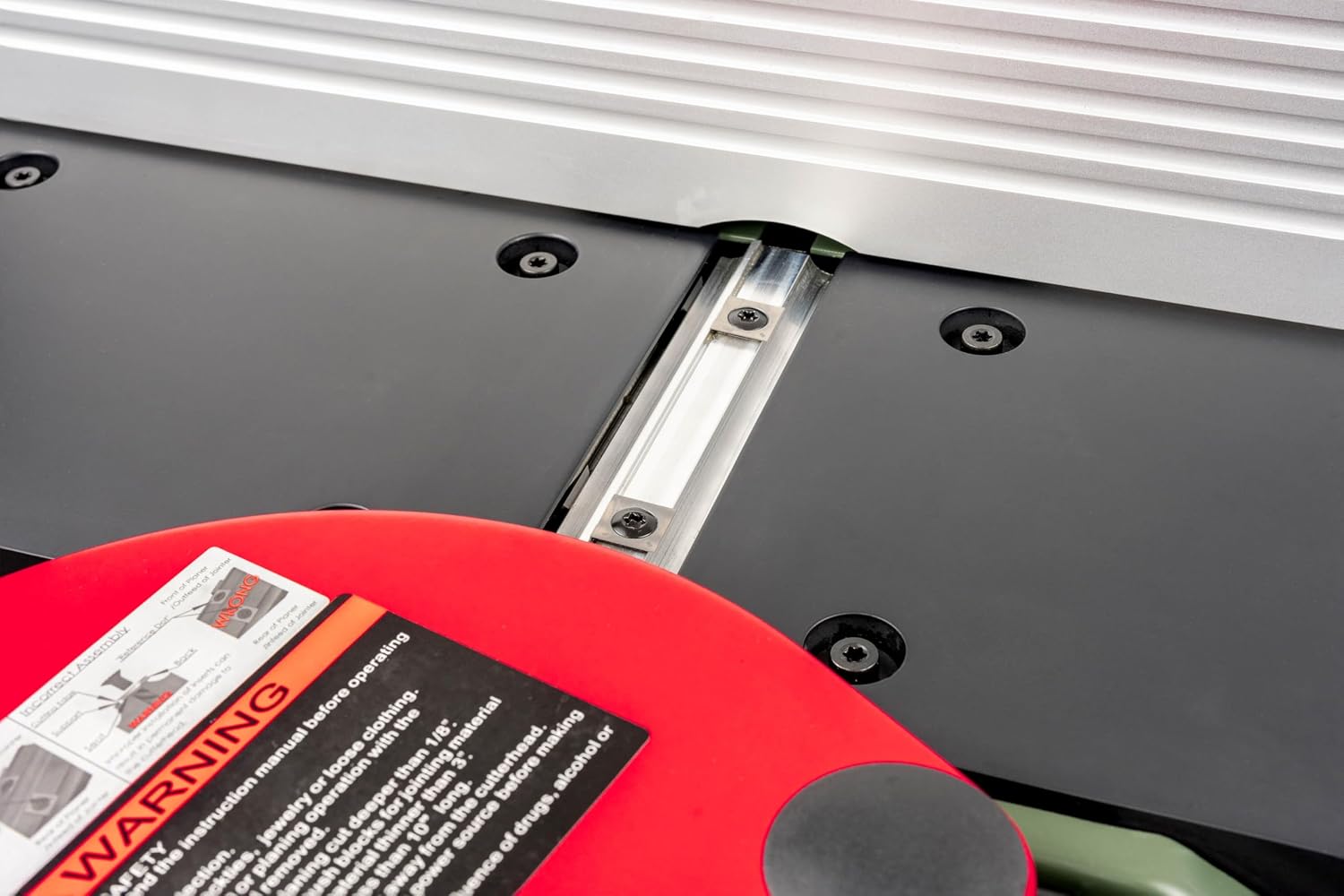
If you’ve ever tried to build a cabinet or a tabletop and ended up with boards that rock, cup, or won’t glue up flat, you’ve already felt the problem this article solves. The fix is a two-machine sequence: a jointer (a flat, spinning-cutter tool that gives one face and one edge of a board a dead-flat reference surface) followed by a thickness planer (which makes the opposite face parallel to that reference, so the board ends up a consistent, true thickness all the way through). Together, they turn rough, warped lumber into the flat, square stock that every precise woodworking project depends on. The catch, for most of us, is space. A floor-standing 8-inch jointer and a 15-inch planer can eat 40–60 square feet of floor space before you’ve even added outfeed room. This guide is about making that two-machine workflow happen in a shop under 400 square feet — without downgrading to results you’ll regret.
Why the Sequence Matters Before the Machine Choice Does
It’s tempting to jump straight to “which jointer should I buy,” but the bigger mistake intermediate woodworkers make is buying the machines in the wrong order — or skipping one entirely and wondering why their glue-ups keep failing.
The jointer goes first. Always. You cannot thickness-plane a cupped or twisted board and get a flat result; the planer’s rollers press the board flat temporarily, then release it, and it springs back to whatever shape it started with. Fine Woodworking’s guidance on machine sequencing makes this point plainly: the jointer creates the datum — the reference surface the planer works from. Skip the jointer, and the planer is just making your crooked board uniformly thin.
The practical implication for a small shop is that you need both machines, not one or the other. The question is which form factor fits your reality.
The three configurations worth considering:
-
Benchtop jointer (6-inch) + benchtop or lunchbox planer (12–13 inch): The classic small-shop pairing. Both machines sit on a workbench or mobile base when not in use. Low footprint, lower investment.
-
Combo jointer-planer (also called a “over-under” machine): One machine does both jobs by switching configurations. Popular in European cabinetmaking traditions. Compact footprint, but with workflow compromises worth knowing.
-
Full-size floor jointer (6–8 inch) + portable planer (13–15 inch): The best performance-per-dollar at the intermediate level, if you have the floor space for a permanent jointer footprint.
Benchtop Jointer Reality Check: The 6-Inch Ceiling
The 6-inch benchtop jointer is the entry point for most small-shop woodworkers, and it’s genuinely capable — with honest limits. Published specs from mainstream models like the Jet JJ-6HHDX or the Powermatic 54A put infeed/outfeed tables in the 24–28-inch range. That’s workable for boards up to about 36 inches before you’re fighting the physics of unsupported stock.
Owners across aggregated reviews on Toolbox Buzz and Popular Mechanics roundups consistently flag two real constraints:
- Width capacity: A 6-inch jointer can’t flatten boards wider than 6 inches in a single pass. For tabletops or wide panels, you’re either ripping boards narrower first or accepting that you’ll need to take multiple passes and hand-plane the seam.
- Fence rigidity: On benchtop models, the fence — the vertical guide that keeps the board square while you joint an edge — tends to have more flex than a floor-standing machine. That flex compounds into out-of-square edges if you’re not checking frequently.
If your primary work is furniture with solid-wood components under 5 inches wide — chair parts, drawer fronts, cabinet face frames — a good 6-inch benchtop jointer handles it cleanly. If you’re milling wide slabs or building broad tabletops regularly, you’ll outgrow it fast, and the resale case for stepping up to an 8-inch floor model becomes compelling.
Buy the 6-inch benchtop if: your boards are consistently under 5 inches wide, you’re working with S2S (surfaced-two-sides) lumber where only edge-jointing is needed, and your shop simply cannot accommodate a floor-standing machine even on a mobile base.
Step up to an 8-inch floor model if: you’re milling rough lumber wider than 5 inches, building dining tables or wide case pieces, or expect to sell or pass on this machine — 8-inch floor jointers from Jet, Powermatic, and Grizzly hold resale value significantly better than benchtop models, per patterns visible across used-tool markets in 2025–2026.
Planer Selection: Where the Small Shop Gets the Better Deal
Here’s the honest counterintuitive truth about small-shop planer selection: the gap between a benchtop “lunchbox” planer and a full-size cabinet planer is smaller than the jointer gap, especially for hobbyist and intermediate volumes.
The DeWalt DW735X (13-inch, two-speed) and Ridgid TP13002 have both accumulated years of owner feedback pointing to the same conclusion: for boards under 13 inches wide and milling sessions under two hours, the performance difference from a floor-standing 15-inch machine is real but not decisive. Wood Magazine’s planer buyer’s guide puts the DW735X’s material removal rate and snipe characteristics in a competitive bracket with machines costing significantly more, when matched on board width.
Where the benchtop planer loses:
- Snipe: The slight dig at the beginning and end of a board as the rollers engage and release. Benchtop planers produce more snipe than cabinet planers. The workaround — milling boards 4–6 inches longer than needed and trimming the snipe off — works, but it’s a real cost in material.
- Dust collection: Benchtop planers throw chips aggressively. A 4-inch dust port connected to a decent shop vac or dust collector isn’t optional; it’s the difference between a usable workflow and a cleanup nightmare.
- Noise and vibration at depth: Taking more than 1/16-inch per pass on figured or reversing-grain stock stresses benchtop machines in ways operators in long-run reviews frequently flag as a concern for longevity.
By the numbers:
| Machine class | Typical price range (2026) | Max width | Snipe typical | Resale at 5 years |
|---|---|---|---|---|
| Benchtop planer (12–13 in) | $350–$600 | 13 in | 1/16–3/32 in | 40–55% of purchase |
| Cabinet planer (15 in) | $1,800–$3,500 | 15–20 in | Minimal | 60–75% of purchase |
| Combo jointer-planer | $800–$2,200 | 10–12 in joint / 12–13 in plane | Moderate | Variable, brand-dependent |
The Combo Machine Question: Honest Tradeoffs
The jointer-planer combo — machines like the Hammer A3-31 or Felder AD-series, or budget-side options from Grizzly and Rikon — compresses both functions into a single footprint. For shops under 200 square feet, the appeal is obvious.
The tradeoffs are equally obvious once you’re in the workflow:
Switching time: Reconfiguring from jointer mode to planer mode takes 3–10 minutes depending on the machine. That kills the rhythm of iterative milling — joint a face, check flatness, plane to thickness, check, repeat. Every check breaks the sequence. Operators in Fine Woodworking’s forum coverage consistently note that combo machines change how you batch your work: you joint everything first, then switch and plane, rather than working board by board.
Cutterhead compromise: On most combo machines under $1,500, the cutterhead is optimized for one function slightly more than the other. European machines (Hammer, Felder, SCM) engineer the compromise more successfully — and price accordingly. At the $900–$1,400 price point, owners report that planer results are generally excellent while the jointing function is adequate but not exceptional for edge-jointing precision work.
The real case for combos: If your shop is genuinely space-constrained (under 200 square feet), you’re building furniture rather than production cabinetry, and you’re willing to batch your milling in stages, a quality combo machine is a legitimate choice — not a compromise to apologize for. Hammer and Felder machines in this category hold resale value well; their European engineering and parts support make them viable long-term investments, not disposable tools.
The case against combos: If you can find the footprint for two separate machines — even benchtop units on mobile bases — the workflow efficiency almost always wins. Two machines running in sequence is simply faster, especially once you’ve developed a rhythm.
Workflow Setup for Tight Spaces: The Mobile Base Strategy
The single most effective small-shop strategy isn’t buying different machines — it’s buying the right machines and making them mobile.
A good mobile base (HTC, Bora Portamate, and Grizzly all manufacture purpose-built options for common machine sizes) turns a floor-standing jointer from a space commitment into a stored asset. The setup that works for shops in the 250–400 square foot range, per patterns in hobbyist shop tours covered by Popular Mechanics and This Old House:
- Jointer on a locking mobile base, stored against a wall or under a workbench when not in use. Roll it out, lock it, joint your stock, roll it back.
- Planer on a dedicated stand or Systainer-style cart, positioned so outfeed clears the wall by at least 6 feet (the length of most boards you’ll be milling).
- A single “milling zone” — clear floor space, usually in the center of the shop — that both machines temporarily occupy when in use. You’re not running both simultaneously; the jointer and planer take turns in that zone.
The outfeed question trips up most small-shop woodworkers. A 6-foot board needs 6 feet of supported outfeed to avoid tip-and-snipe at the exit. Roller stands — simple, adjustable, inexpensive — solve this without occupying permanent floor space. Keep two or three folded against a wall. This Old House’s jointer workflow guidance emphasizes outfeed support as the step most beginners skip and most experienced woodworkers regret skipping.
The Decision Rule
If you’re setting up a small shop for the first time and you’re milling boards under 5 inches wide from S2S stock: start with the planer, get a good benchtop unit, and add the jointer second. A planer without a jointer still moves you forward; a jointer without a planer less so.
If you’re milling rough lumber and building furniture with wide components, and your shop is 250 square feet or larger: buy a floor-standing 6-inch jointer and a DeWalt DW735X-class planer, both on mobile bases. This pairing gives you legitimate results at a total investment under $1,500 and resale flexibility you won’t regret.
If your shop is genuinely under 200 square feet and you build furniture in batches rather than one-offs: a quality European combo machine (Hammer A3-31 or equivalent) justifies the premium. The workflow shift is real, but the footprint savings are real too, and the resale math holds better than it does for budget combos.
The one choice that consistently disappoints across aggregated owner reviews: buying the cheapest jointer and the cheapest planer to save money, and then buying better machines two years later anyway. The machines that hold resale value — Jet, Powermatic, Hammer, Grizzly’s industrial line — are the ones worth buying once.