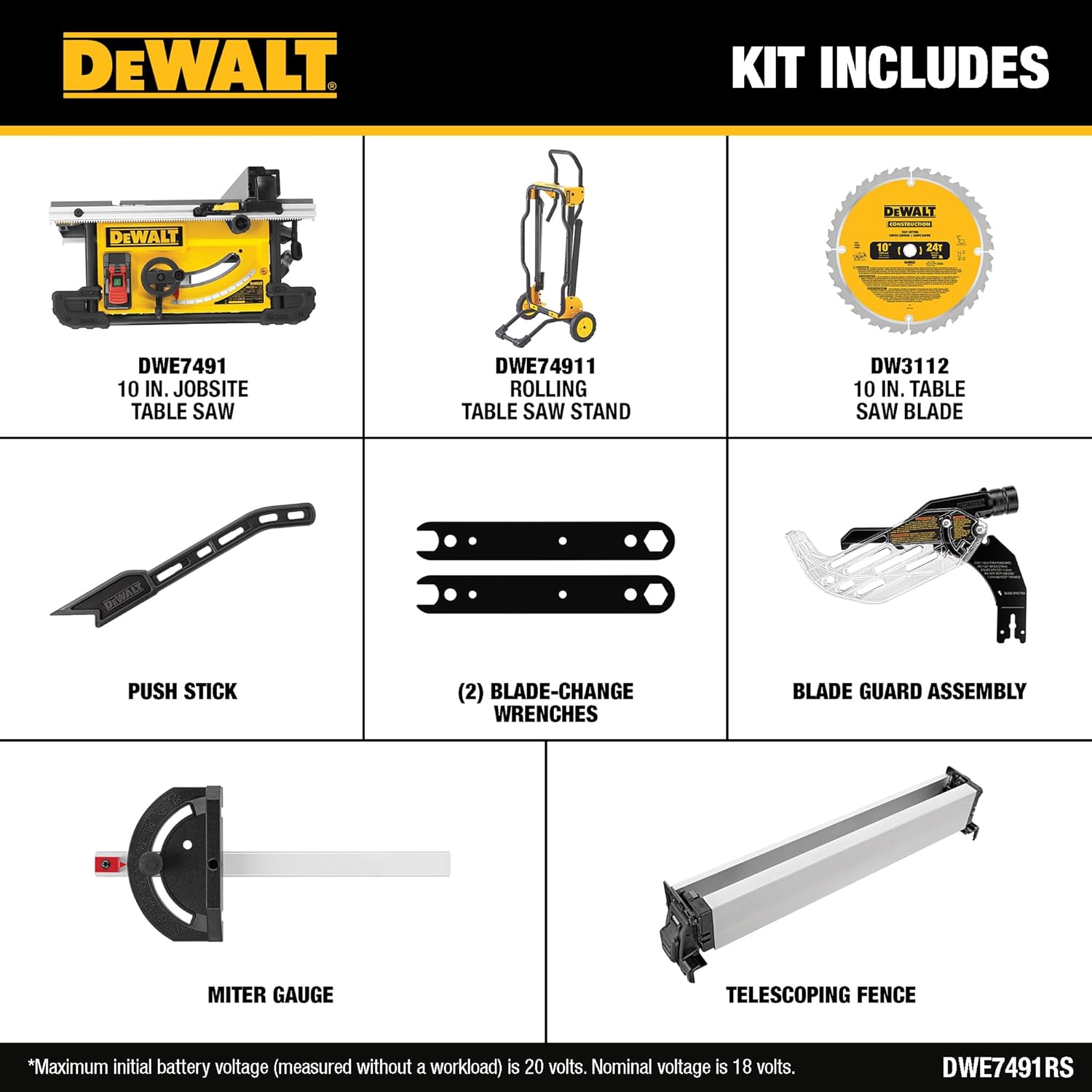
A table saw is the centerpiece of most woodworking shops — the machine every other tool orbits. A jobsite table saw is the lightweight, portable version: compact enough to fold up and carry to a renovation site, typically running on a standard 120-volt household outlet, and priced under $600. Millions of woodworkers start here, and there’s nothing wrong with that. But “jobsite” is a design philosophy, not just a marketing label. Those saws are engineered for portability, which means tradeoffs in mass, fence precision, and motor power that don’t matter much when you’re cutting subfloor — but start costing you time, accuracy, and frustration when you’re building furniture or cabinets. This guide is for the moment you’ve noticed those tradeoffs adding up. We’ll walk through the honest signals that you’ve outgrown your saw, lay out the three upgrade categories you’re actually choosing between, and give you clear decision rules so you’re not second-guessing a $2,000 purchase for the next six months.
| EDITOR'S PICK[SKIL 10 Inch Heavy Duty Worm Dr…](https://www.amazon.com/dp/B07657FP2G?tag=greenflower20-20) | Mid-tier[DEWALT Table Saw](https://www.amazon.com/dp/B0842QDW95?tag=greenflower20-20) | Budget pick[DEWALT Table Saw 10 Inch with F…](https://www.amazon.com/dp/B00F2CGXGG?tag=greenflower20-20) | |
|---|---|---|---|
| Rip capacity | — | 32-1/2 in | 32-1/2 in |
| Motor power | — | 15 Amp | 15 Amp |
| Speed | — | — | 4800 RPM |
| Dust collector | — | ✓ | — |
| Price | $749.00 | $729.00 | $649.00 |
| See on Amazon → | See on Amazon → | See on Amazon → |
How to Know You’ve Actually Outgrown It
This is the question most people skip, buying up because they want to rather than because the saw is genuinely holding them back. Both are valid reasons, but they lead to different buying decisions, so let’s be honest about which camp you’re in.
The saw is the constraint if:
- Your fence drifts, requires constant re-squaring, or won’t hold a repeatable setting across a session. Jobsite fences are stamped steel mounted to aluminum rails; they flex. On a furniture or cabinet project, a fence that wanders 1/32″ over a 48-inch rip ruins the joint.
- You’re ripping hardwood over 1½ inches thick and the motor bogs or trips the breaker. Most jobsite saws run a 15-amp, 120-volt universal motor — adequate for plywood and soft lumber, genuinely undersized for dense hardwoods at depth.
- Vibration is moving your workpiece or making tearout worse than it should be. Mass dampens vibration. A saw that weighs 50 lb on a folding stand vibrates; a contractor saw at 250 lb does not.
- Your dado stack (a set of stacked blades used to cut wide grooves, like for shelving) won’t fit, or the saw explicitly doesn’t support one. Many jobsite saws have a ⅝-inch arbor (the shaft the blade mounts to) but insufficient arbor thread length for a full stack.
The saw is not the constraint if you’re producing work you’re happy with, your limiting factor is skills or workflow, and the upgrade is really about wanting a nicer shop. Again — totally valid — but then you’re making a lifestyle purchase, not a capacity purchase, and the math looks different.
The Three Categories You’re Actually Choosing Between
Once you’ve decided to upgrade, the market splits into three meaningful tiers. The names matter less than the engineering decisions behind them.
Contractor and Hybrid Saws ($600–$1,800)
A contractor saw sits on a open-leg stand, runs on 120 volts, and weighs 200–300 lb — three to five times the mass of a jobsite saw. That mass alone solves the vibration problem. Better still, contractor and hybrid saws ship with real fence systems: Biesemeyer-style T-square fences (a design where the fence locks to a front rail only, allowing fast, accurate positioning) that hold a setting without drift.
Hybrid saws split the difference between contractor and cabinet saw design — they use an enclosed cabinet base (which contains the dust and adds rigidity) but still run on 120 volts. The Jet JWTS-10JF, the Ridgid R4512, and the Grizzly G0715P are commonly referenced in this category. Toolbox Buzz’s long-run operator reviews consistently note that hybrid saws punch well above their price on fence accuracy and vibration control, while falling short of cabinet saws in motor power and dust collection efficiency.
Buy here if: You’re in a garage shop on a single 20-amp circuit. You don’t run a three-phase service, you don’t want to rewire, and you need a real fence and real mass without a $3,000 commitment. This is the right saw for intermediate furniture work, face frames, and most cabinet carcasses.
Cabinet Saws ($1,800–$4,500)
A cabinet saw runs a 240-volt induction motor (typically 3–5 hp), sits on a fully enclosed steel cabinet, and weighs 500–700 lb or more. The enclosed cabinet means dust collection actually works — a single 4-inch port at the bottom of the cabinet captures the vast majority of blade dust, which matters for finishing and for your lungs. The induction motor (as opposed to the universal motors in jobsite and some contractor saws) runs quieter, produces less radio-frequency interference, and lasts longer under sustained load.
This is the category that includes the Powermatic PM2000B, the Jet J-52221, and the SawStop Professional Cabinet Saw. The SawStop warrants specific mention: it uses a safety system that detects skin contact and stops the blade in under 5 milliseconds, a feature that Fine Woodworking’s buyer’s guide notes has become a serious consideration for dedicated shop owners who work alone. SawStop saws run $3,500–$5,000+ depending on configuration, but owners and insurance actuaries both treat that price differently once you price out a hand surgery.
By the numbers:
| Category | Typical weight | Motor | Voltage | Fence quality | Street price (2026) |
|---|---|---|---|---|---|
| Jobsite saw | 45–65 lb | 15A universal | 120V | Stamped rail | $300–$600 |
| Contractor/Hybrid | 200–320 lb | 15–20A universal/induction | 120V | T-square style | $600–$1,800 |
| Cabinet saw | 500–700+ lb | 3–5 hp induction | 240V | Precision T-square | $1,800–$5,000+ |
Buy here if: You’re doing sustained production work — multiple cabinet jobs, high-volume hardwood ripping, or any scenario where you’re running the saw for hours rather than sessions. Also buy here if you’re wiring a new dedicated shop space and can spec a 240-volt circuit at the design stage. The motor longevity and dust collection payoff at this tier are real over a five-year horizon.
The Sliding Table Saw ($3,000–$15,000+)
A sliding table saw adds a rolling table alongside the main blade that travels past the blade on precision bearings, making crosscuts and panel cuts dramatically more accurate and safer than using a miter gauge (the small protractor-style guide on standard saws). European cabinet shops run almost exclusively on sliding table saws; North American shops have been slower to adopt them, but that’s shifting.
Brands like Felder, Hammer (Felder’s hobbyist line), SCM, and Laguna all sell sliding table saws to serious domestic buyers. Wood Magazine’s contractor-versus-cabinet comparison work touches on sliding table geometry as the key differentiator for panel work — the ability to break down a full 4×8 sheet accurately in a single pass without an outfeed table is a genuine shop-floor efficiency gain.
Buy here if: You’re building furniture or cabinetry at a production pace, you regularly process full sheet goods, or you’re outfitting a small professional shop where time-per-part matters. This isn’t an impulse buy — the footprint alone (often 10–14 feet of table travel) requires a shop designed around it.
The Math You Should Actually Run
Before you finalize a budget, run two quick calculations that most buyers skip.
Cost-per-use over five years. A $1,200 hybrid saw used two weekends a month for five years costs roughly $10 per session before you factor in resale. A $3,500 cabinet saw on the same cadence costs about $29 per session. That gap is real, but it narrows fast if you work more frequently — and cabinet saws hold resale value significantly better than contractor saws. Popular Mechanics’ table saw roundup notes that used Powermatic and SawStop cabinet saws routinely sell at 60–75% of purchase price years later; used hybrid saws depreciate closer to 40–50%.
Electrical upgrade cost. If you’re stepping to a cabinet saw for the first time, get a quote from an electrician before you order the saw. In most U.S. markets in 2026, running a new 240-volt, 30-amp circuit in an existing garage costs $300–$700 depending on panel location and conduit run. That cost belongs in your total budget. If it pushes you over, the hybrid tier on 120 volts is a legitimate answer, not a compromise.
What to Buy Alongside the Saw
The saw upgrade is the headline, but it usually exposes two adjacent gaps: outfeed support and dust collection.
Outfeed table. A full-sized cabinet saw will feed an 8-foot board off the back with nothing to catch it. A dedicated outfeed table — or a well-placed assembly table at the same height — is not optional once you’re milling lumber. This Old House’s shop setup guides consistently list outfeed support as the most common thing experienced woodworkers wish they’d built at the same time as the saw install.
Dust collection. The jump from a jobsite saw (which mostly throws chips at you) to a cabinet saw (which actually cooperates with a dust collector) means a shop vac is no longer adequate. A 1.5–2 hp single-stage dust collector from Jet, Grizzly, or Laguna runs $300–$600 and is the correct pairing for a cabinet saw. If you’re building out a full shop, Oneida and Penn State Industries cyclone separators add upstream separation that dramatically extends filter life — operators in long-run reviews consistently note a 70–80% reduction in filter cleaning frequency after adding a cyclone stage.
Clear Decision Rules
If you’re ripping hardwood regularly, building cabinets or furniture (not just trim and subfloor), and you have a 240-volt circuit available or can add one for under $500 — buy a cabinet saw. The SawStop Professional Cabinet Saw is the clear recommendation for anyone working alone; the Powermatic PM2000B is the recommendation for anyone who wants proven long-run reliability and doesn’t need the safety system at that premium.
If you’re on 120 volts and want to stay there — buy a hybrid saw. The Jet JWTS-10JF or Grizzly G0715P will solve the fence and vibration problems that are actually limiting you.
If you build production furniture, run sheet goods daily, or are outfitting a shop as a capital expense — price the sliding table saw first. The footprint and cost are real, but so is the throughput advantage. Felder’s entry-level Hammer series puts a genuine sliding table in reach around $3,500–$5,000, which reframes the comparison against a top-spec cabinet saw more favorably than most buyers expect.
Your jobsite saw didn’t fail you. It did exactly what it was designed to do. The upgrade question isn’t whether the old saw is bad — it’s whether the tradeoffs that made it portable are now costing you more than the upgrade does. Run that math honestly, and the answer usually comes into focus fast.