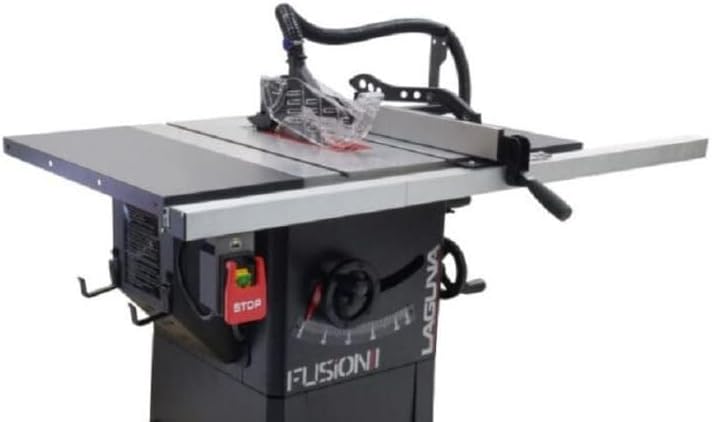
A table saw is the centerpiece of almost any serious woodworking shop — it’s the machine you build your workflow around, not an afterthought. For most home woodworkers and dedicated hobbyists, the decision isn’t whether to buy a table saw, it’s which class of saw makes sense. The $1,500–$2,500 range is where a specific, important category lives: saws that behave like professional cabinet saws (heavy, stable, precise, designed for production work) but are priced and sized for people who aren’t running a commercial shop. These are sometimes called hybrid saws — machines that blend the power and rigidity of a traditional cabinet saw (which can run $3,500 and up) with the smaller footprint and lower price of a contractor-grade saw (typically under $900). The Laguna Fusion is one of the most-discussed models in this band. This guide explains who should buy it, what the real competition looks like, and how to make the call cleanly.
What “Hybrid” Actually Means — and Why It Matters Here
The term “hybrid” gets used loosely in table saw marketing, so let’s nail it down. In practical terms, a hybrid saw combines:
- A fully enclosed cabinet base (like a traditional cabinet saw), which damps vibration and keeps dust contained
- An induction motor mounted inside the cabinet rather than hanging off the back like a contractor saw — which also reduces vibration and makes the saw dramatically quieter under load
- A direct or belt-drive system that typically runs a 1.75–3 HP motor on standard 110V or 240V power
The payoff versus a contractor saw is real. Owners consistently report that hybrid saws hold calibration longer, produce less table vibration during rip cuts, and simply feel more planted — like the difference between a workbench bolted to the floor and one that shifts when you lean on it. Fine Woodworking’s comparison reviews of hybrid and cabinet saws have repeatedly made the point that the enclosed cabinet base is doing significant mechanical work that’s invisible until you’ve used both classes back to back.
The tradeoff versus a full cabinet saw is weight (hybrids are typically 200–350 lbs vs. 400–600+ lbs for true cabinet saws), motor ceiling (most hybrids top at 1.75–3 HP vs. 3–5 HP for cabinet saws), and, honestly, resale value — a SawStop or Powermatic cabinet saw holds its value on the used market in a way most hybrids don’t.
That last point matters if you treat tool purchases as capital expenditures. But if you’re in the $1,500–$2,500 band, you’re not buying for resale — you’re buying for a decade of use.
The Laguna Fusion: What the Specs and Owner Reports Actually Show
The Laguna Fusion (currently available in Fusion 1 and Fusion 3 configurations, at roughly $1,699–$2,299 depending on the variant and retailer at time of publishing) has become a recurring recommendation in this price band, and the reasons show up consistently in aggregated owner reviews and editorial evaluations.
Published specs on the Fusion 3:
- 3 HP induction motor (240V)
- 30” rip capacity (distance from blade to right fence rail)
- T-slot aluminum fence with a reputation for staying square over time
- ~350 lb cabinet weight
- Riving knife (a blade-adjacent safety feature that moves with the blade and prevents wood from pinching during cuts — important for safety)
- Blade guard and anti-kickback pawls standard
Wood Magazine’s roundup of home-shop table saws named the Fusion among the top considerations in this tier specifically because of the fence system. A fence that drifts or flexes under pressure forces you into tedious recalibration and produces inconsistent rip widths — the fence is arguably the most use-critical component on a table saw, and owner reports on the Fusion consistently call it out positively. Toolbox Buzz’s hybrid saw coverage echoes this, noting that fence quality at this price point separates saws that stay dialed in from ones that require constant babysitting.
Where owners note friction: The Laguna Fusion’s dust collection port is functional but some owners report needing an upgrade to a 4” dust collector (the standard hookup) to keep the cabinet clean during sustained cutting sessions. The factory blade is considered adequate but not exceptional — most serious hobbyists swap it for an aftermarket blade (Freud, Forrest, or Tenryu are the commonly cited upgrades) within the first few months. Neither of these are dealbreakers; they’re just honest costs to factor in.
By the Numbers: Mid-Range Hybrid Saw Comparison
| Saw | Approx. Price (2026) | Motor | Rip Capacity | Weight |
|---|---|---|---|---|
| Laguna Fusion 3 | ~$2,299 | 3 HP / 240V | 30” | ~350 lbs |
| Jet Proshop ITS | ~$1,799 | 1.75 HP / 110V | 30” | ~280 lbs |
| Powermatic PM1000 | ~$2,499 | 1.75 HP / 110V | 30” | ~310 lbs |
| Grizzly G0690 | ~$1,595 | 2 HP / 110–240V | 30” | ~330 lbs |
Prices sourced from published retail listings as of Q1 2026. Verify current pricing before purchase.
The Real Competition: Jet, Powermatic, and Grizzly
Buying at this price point without running the comparison is leaving money (or capability) on the table. Here’s how the field actually breaks down.
Jet Proshop ITS (~$1,799): The Jet is the 110V option in this comparison, which is its primary selling point. If your shop runs on a standard household circuit and you’re not willing or able to run a 240V line, the Jet is the serious hybrid choice. It gives up motor power (1.75 HP vs. 3 HP) and some cabinet mass, but Popular Mechanics and This Old House both consistently cite it for build quality and support network. Jet’s dealer and parts infrastructure in North America is strong — a real consideration for a machine you plan to run for 10+ years.
Powermatic PM1000 (~$2,499): The Powermatic occupies the top of this band and prices right at the SawStop Contractor Saw territory. For the money, you get excellent fit and finish, a smooth fence, and the Powermatic brand reputation, which has historically been strong for resale. The tradeoff is still 110V / 1.75 HP, same as the Jet, and owners in long-run reviews note that while the PM1000 is a genuinely fine saw, the value argument over the Laguna or Grizzly becomes harder to make at that price point unless brand heritage or resale value weigh heavily in your decision.
Grizzly G0690 (~$1,595): This is the budget floor of serious hybrid saws, and Grizzly’s proposition is simple: you get a full-cabinet hybrid with a 2 HP motor and solid cast iron table for substantially less money, but you’re accepting a fence that many owners consider the weakest component of the package and a parts/support experience that depends heavily on whether you’re comfortable diagnosing and fixing problems yourself. Fine Woodworking’s community coverage of the Grizzly hybrid saws reflects a consistent theme: experienced woodworkers who know how to tune a saw get excellent value; beginners who want a plug-and-play experience sometimes struggle.
The SawStop Threshold Question
Any honest mid-range cabinet saw guide has to address SawStop, because the question comes up every time. The SawStop Contractor Saw starts at approximately $1,799 and the Professional Cabinet Saw starts at $3,499 — so the lower-end SawStop enters this price band. SawStop’s defining feature is its flesh-detection safety system: the blade stops and retracts within milliseconds of contact with skin, which is why it appears in schools, professional shops, and insurance-sensitive environments. Reviewers across Fine Woodworking, This Old House, and Wood Magazine consistently note the SawStop Contractor Saw as a legitimate contender at the high end of this price band, with the caveat that it’s a contractor-class machine (not a cabinet saw in the traditional sense) with the SawStop system adding significant cost.
The decision rule: If you have a family member learning to use the shop, if you ever work fatigued or distracted, or if the cost of a serious hand injury would be catastrophic (professionally or financially), the SawStop premium is a legitimate safety expenditure, not a luxury. If you’re an experienced woodworker with strong safety habits, the SawStop’s blade-stop system is a feature you’re paying for but may never use — and the same $1,800 buys you a Jet or Laguna with more machine.
How to Decide: The Clear “If X, Then Y” Framework
After working through the specs and aggregated owner experience, here’s where each machine makes sense:
If you’re wiring a dedicated shop and can run 240V → Laguna Fusion 3. The 3 HP induction motor, fence quality, and cabinet mass represent the best value in this band at the full-power configuration. It’s the pick for someone who will push the saw with thick hardwood rips on a regular basis.
If you’re on 110V and want a reliable name-brand machine with strong dealer support → Jet Proshop ITS. You give up motor ceiling but gain flexibility and a rock-solid support network.
If brand heritage and resale value matter as much as raw specs → Powermatic PM1000. It costs more than it should at this power level, but it’s a Powermatic, and that carries weight in the used-tool market.
If you’re experienced enough to tune a saw yourself and budget is the binding constraint → Grizzly G0690. Best dollar-per-pound-of-cast-iron in the class; requires a competent operator.
If anyone in your shop is new to table saws, or if safety margin is your priority → SawStop Contractor Saw, even at the top of this band. The flesh-detection system changes the risk calculus in a way that no fence system or motor spec can replicate.
One final note on long-term cost of ownership, which shapes every recommendation here: at this price tier, the saw you buy will likely outlast its relevance to your skill growth before it mechanically fails. Buy toward the top of what your power supply and budget allow, keep the blade sharp (a dull blade is where most table saw problems begin), and consider the fence quality above almost everything else when you’re standing in the aisle deciding. The cut is only as good as what’s guiding it.