A cabinet table saw is the centerpiece of a serious woodworking shop — a floor-standing, heavy-duty machine (usually 600 lbs or more) with a large cast-iron table, a powerful enclosed motor, and the precision needed to cut sheet goods and solid lumber accurately for years. Unlike the portable job-site saws you see on a construction site, a cabinet saw is a permanent shop investment. It’s the machine you buy once and use for the next twenty years. Two names come up in nearly every serious buying conversation: SawStop and Powermatic. SawStop is famous for its patented safety system that stops the blade in milliseconds if it detects skin contact. Powermatic has been building cabinet saws since 1921 and is widely regarded as the benchmark for fit, finish, and long-term reliability. This article is a direct comparison — with the math shown — so you can make a confident decision rather than a hopeful one.
| EDITOR'S PICK[SAWSTOP Professional Cabinet Saw](https://www.amazon.com/dp/B0FX397ZJP?tag=greenflower20-20) | Mid-tier[JET 10-Inch Deluxe XACTA Table](https://www.amazon.com/dp/B000WO4HUI?tag=greenflower20-20)… | Budget pickPowermatic 10-Inch Table Saw | |
|---|---|---|---|
| Motor Power | 3HP | 3 HP | 1-3/4 HP |
| Rip Capacity | 36" | 50-Inch | 30-Inch |
| Fence Type | T-Glide Advance | XACTA | — |
| Voltage | — | 230V 1Ph | 115/230V 1Ph |
| Price | $4,353.00 | $4,124.00 | $3,299.00 |
| See on Amazon → | See on Amazon → | See on Amazon → |
What You’re Actually Buying: Specs, Safety, and the Real Sticker Price
Let’s put the numbers on the table first, because the price gap is real and it matters.
Mid-2026 market pricing:
| Model | Street Price | Motor | Rip Capacity | Weight | Tier |
|---|---|---|---|---|---|
| Powermatic PM2000B (3HP) | ~$2,800–$3,200 | 3 HP, 1.75” arbor | 30” or 50” fence options | ~650 lbs | JET JTAS-10XL50-1DX — $4,124.00 |
| SawStop Professional Cabinet Saw (PCS, 3HP) | ~$3,500–$3,800 | 3 HP, 1.75” arbor | 30” or 52” fence options | ~620 lbs | JET JTAS-10XL50-1DX — $4,124.00 |
| Powermatic PM2000B (5HP) | ~$3,600–$4,000 | 5 HP | 50” | ~690 lbs | SAWSTOP PCS31230-ATGP36 — $4,353.00 |
| SawStop Industrial Cabinet Saw (ICS, 5HP) | ~$5,200–$5,800 | 5 HP | 36” or 52” | ~720 lbs | SAWSTOP PCS31230-ATGP36 — $4,353.00 |
The SawStop Professional Cabinet Saw (PCS) — the entry point into the SawStop cabinet line — runs roughly $500–$700 more than a comparably specced Powermatic PM2000B at the 3HP tier. At the 5HP level, that gap widens to roughly $1,200–$1,800. That premium funds one thing: the SawStop brake cartridge system, which detects the electrical conductivity of human skin and fires an aluminum brake into the spinning blade in under 5 milliseconds, stopping the blade and dropping it below the table surface. The blade and cartridge are destroyed in the process (replacement cartridge runs about $80–$100), but fingers are not.
Fine Woodworking’s archived cabinet saw reviews describe the SawStop brake mechanism as the most significant passive safety advance in table saw history, noting that the cartridge replacement procedure takes under two minutes. That’s not marketing copy — it’s a sober assessment from experienced woodworkers who understand the stakes.
The Powermatic PM2000B offers no equivalent active safety system. What it does offer is the refinement that decades of cabinet saw manufacturing produces: extremely tight fence tolerances, a robust trunnion assembly (the internal mechanism that lets the blade tilt), and a heritage of parts availability that Powermatic owners cite consistently in long-term ownership discussions.
The Price-Per-Use Math: How to Actually Think About This
Here’s where the analysis gets concrete. “Price-per-use” sounds abstract, but it’s the right frame for a stationary machine you’ll use two to five times a week for fifteen to twenty years.
Assume a serious hobbyist uses their cabinet saw 150 days per year for 15 years — that’s 2,250 uses. A professional custom shop might double that.
SawStop PCS at $3,700 (mid-range street price):
- $3,700 ÷ 2,250 uses = $1.64 per session
- Add one brake cartridge replacement per year at ~$90 = $1,350 over 15 years
- Adjusted total cost of ownership: ~$5,050
- Adjusted price-per-use: $2.24
Powermatic PM2000B at $3,000:
- $3,000 ÷ 2,250 uses = $1.33 per session
- Maintenance costs (belts, wax, tune-up parts) are comparable to SawStop; no cartridge expense
- Adjusted total cost of ownership: ~$3,400–$3,600
- Adjusted price-per-use: ~$1.53
The math is honest: over a 15-year ownership window, the Powermatic costs less per use. The gap is real money when you sum it across years. But that math deliberately excludes the value of the SawStop’s safety system — which is impossible to quantify until it isn’t.
Pro Tool Reviews’ long-form coverage of the PM2000B consistently praises its cast-iron precision and fence quality while acknowledging that the two saws are solving slightly different problems. The Powermatic is optimized for precision and value; the SawStop is optimized for precision and risk mitigation.
The Cases For Each Saw — Stated Without Hedging
The Budget-Conscious Experienced Solo Operator: Powermatic PM2000B
JET JTAS-10XL50-1DX
$4,124.00
In stock on Amazon
Check price on AmazonIf you are an experienced solo operator with disciplined shop habits, the PM2000B makes a compelling case on its own merits — not merely as “the cheaper option.” Wood Magazine’s cabinet saw buyer’s guide rates the PM2000B’s fence system and trunnion precision as top-tier in the category, and long-run owner reviews consistently describe it as “set it and forget it” once properly tuned.
At the 5HP tier, the Powermatic PM2000B undercuts the SawStop ICS by $1,200–$1,800. That spread funds a Festool track saw, a quality dust collector upgrade, or a Mirka DEROS finishing system — real tools that expand shop capability rather than safety overhead for a solo operator who already respects the machine.
This Old House’s tools and equipment coverage makes a point worth repeating here: access to local service is a non-trivial consideration for stationary equipment weighing 650 lbs. Powermatic has a longer-established dealer and service network in rural and secondary markets, and shipping a heavy cabinet saw for warranty work is not a casual undertaking. If you’re outside a major metro, that network matters.
For a production environment where throughput drives decisions, the Powermatic’s smooth magnetic-switch startup and low-vibration performance under continuous use — documented in Pro Tool Reviews’ PM2000B coverage — make it a workhorse with a proven track record in commercial shops.
Buy the Powermatic PM2000B if: You are a solo experienced operator with disciplined habits, you’re price-sensitive at the 5HP tier, or you want to reinvest savings into complementary equipment.
JET JTAS-10XL50-1DX
$4,124.00
In stock on Amazon
Check price on AmazonThe Multi-Person Shop or Teaching Environment: SawStop Professional Cabinet Saw
SAWSTOP PCS31230-ATGP36
$4,353.00
In stock on Amazon
Check price on AmazonThe moment you have anyone else in your shop — an apprentice, a teenage child learning woodworking, a supervised client, a student — the SawStop safety math changes completely. One ER visit for a table saw laceration runs $8,000–$30,000 depending on severity, before you account for lost work time, insurance impacts, or liability exposure.
Toolbox Buzz’s review of the SawStop Professional Cabinet Saw addresses this directly: the brake system is not marketed primarily to experienced operators who already respect the machine — it’s insurance against the moment attention lapses, which happens to everyone eventually. That’s the honest framing.
Popular Mechanics’ 2025 table saw coverage notes that SawStop has become the de facto standard in school woodworking programs and professional training environments. The liability calculation in those contexts is obvious, and the same logic applies to any small custom shop carrying workers’ compensation coverage.
SawStop’s brand recognition in the secondary market is also unusually strong. Used SawStop PCS units frequently sell at 60–70% of original purchase price after five years of use — a meaningfully stronger resale position than comparable used cabinet saws in the same condition. For a shop that upgrades equipment on a 7–10 year cycle, that delta closes a significant portion of the purchase price gap.
Buy the SawStop PCS if: You have anyone else in your shop, run a teaching operation, own a business with employees, or weight resale value heavily in your 10-year cost model.
SAWSTOP PCS31230-ATGP36
$4,353.00
In stock on Amazon
Check price on AmazonThe Intermediate Woodworker Still Building Technique
JET JTAS-10XL50-1DX
$4,124.00
In stock on Amazon
Check price on AmazonThis case deserves its own section because it gets glossed over in most comparisons. If you’re an intermediate woodworker — comfortable with the machine but still developing consistent blade discipline and muscle memory — the SawStop is the right call, and it’s worth stating plainly why.
The SawStop doesn’t make you careless. It adds a backstop that lets you focus on craft rather than anxiety. Fine Woodworking’s coverage of the SawStop platform makes this distinction clearly: the brake system doesn’t eliminate the need for good technique, but it converts a catastrophic mistake into a $90 cartridge replacement. That reframing matters psychologically and practically when you’re still in the learning curve.
The price premium at the 3HP PCS level — roughly $500–$700 over the comparable Powermatic — is a one-time cost spread across 2,000+ uses. At the price-per-use math shown above, that’s less than a dollar per session for a safety net that an intermediate operator has a statistically higher probability of needing than a 20-year veteran.
Buy the SawStop PCS if: You are still building consistent technique and want a safety system that converts a catastrophic error into a minor equipment cost.
JET JTAS-10XL50-1DX
$4,124.00
In stock on Amazon
Check price on AmazonTwo Details That Matter Before You Buy
The Dado Stack Consideration
Both saws accept standard 8-inch dado sets — the stacked blade configuration used to cut wide grooves for cabinet joinery and shelving. SawStop requires a specific dado brake cartridge (approximately $100) in addition to your dado stack, because the brake system must be calibrated for the different blade mass. This is a known, minor ongoing cost. Operators who do heavy dado work report it as negligible over time, but intermediate buyers should factor it into their first-year budget before purchase.
The Fence Question
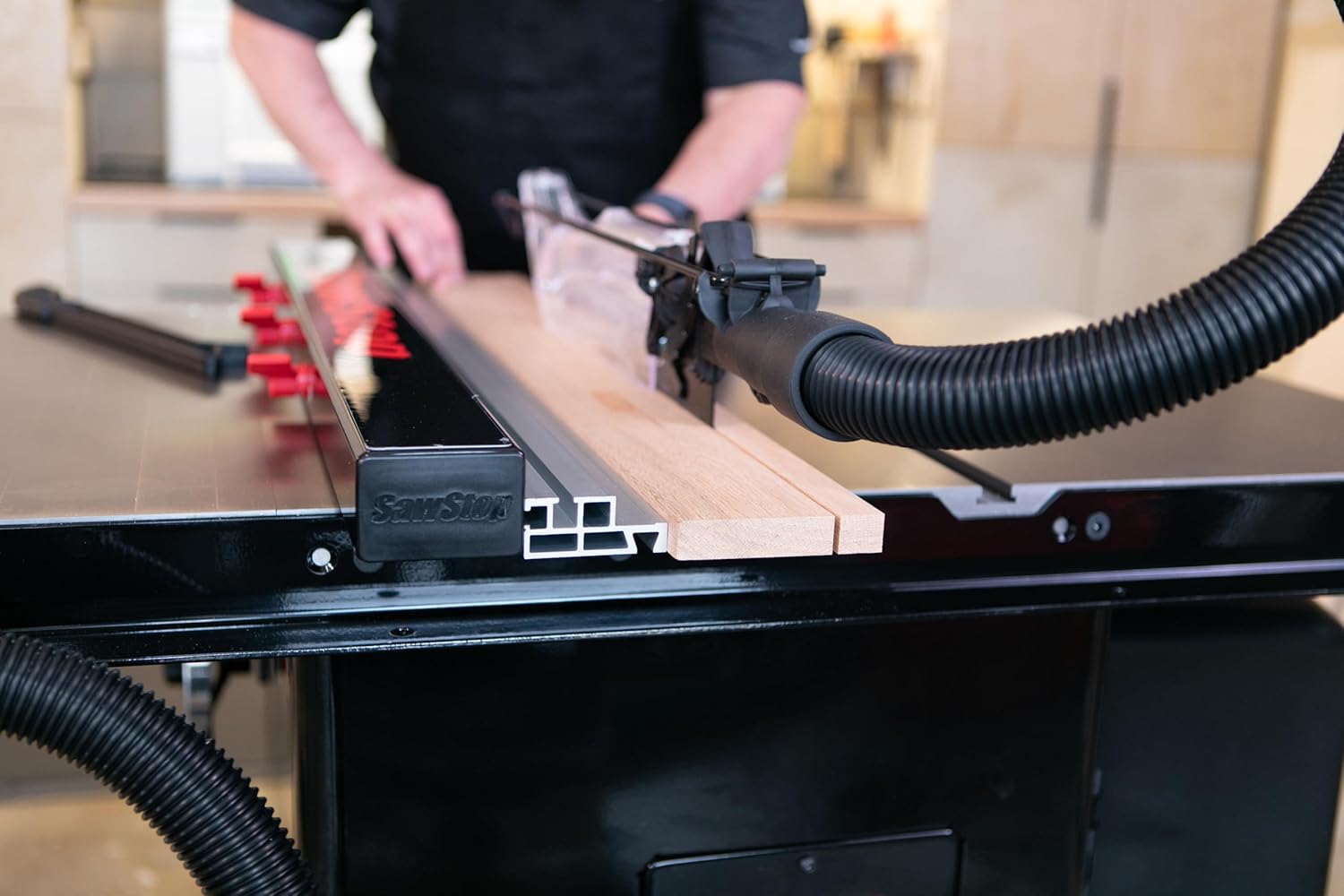
The SawStop PCS ships with the SawStop T-Glide fence; the Powermatic PM2000B ships with the Accu-Fence. Wood Magazine rates the Accu-Fence as one of the best stock fences in the cabinet saw category. Independent operator reviews of the T-Glide describe it as smooth, accurate, and easy to lock parallel to the blade. Neither saw requires an immediate aftermarket fence upgrade — both are ready to work out of the box.
The Decision Rule
If the framework above hasn’t resolved your choice, here’s the cleanest version:
- Anyone else ever in your shop, or any business liability exposure: SawStop PCS. The math is not close once you price a single injury event.
- Solo experienced operator, price-sensitive at the 5HP tier, or reinvesting savings into complementary tools: Powermatic PM2000B. It’s an excellent saw that doesn’t need the safety premium to justify itself.
- Intermediate woodworker still developing technique: SawStop PCS. The backstop is worth more than its cost at this stage.
- Resale value in a 7–10 year ownership window: SawStop. The secondary market premium is real and documented.
Neither saw is a wrong choice. These are two of the most refined cabinet saws available, and either will outlast most of the furniture you build on it. The question isn’t which saw is better in the abstract — it’s which saw is right for your shop, your risk profile, and your 15-year cost model. The math above gives you the framework. The decision is yours.