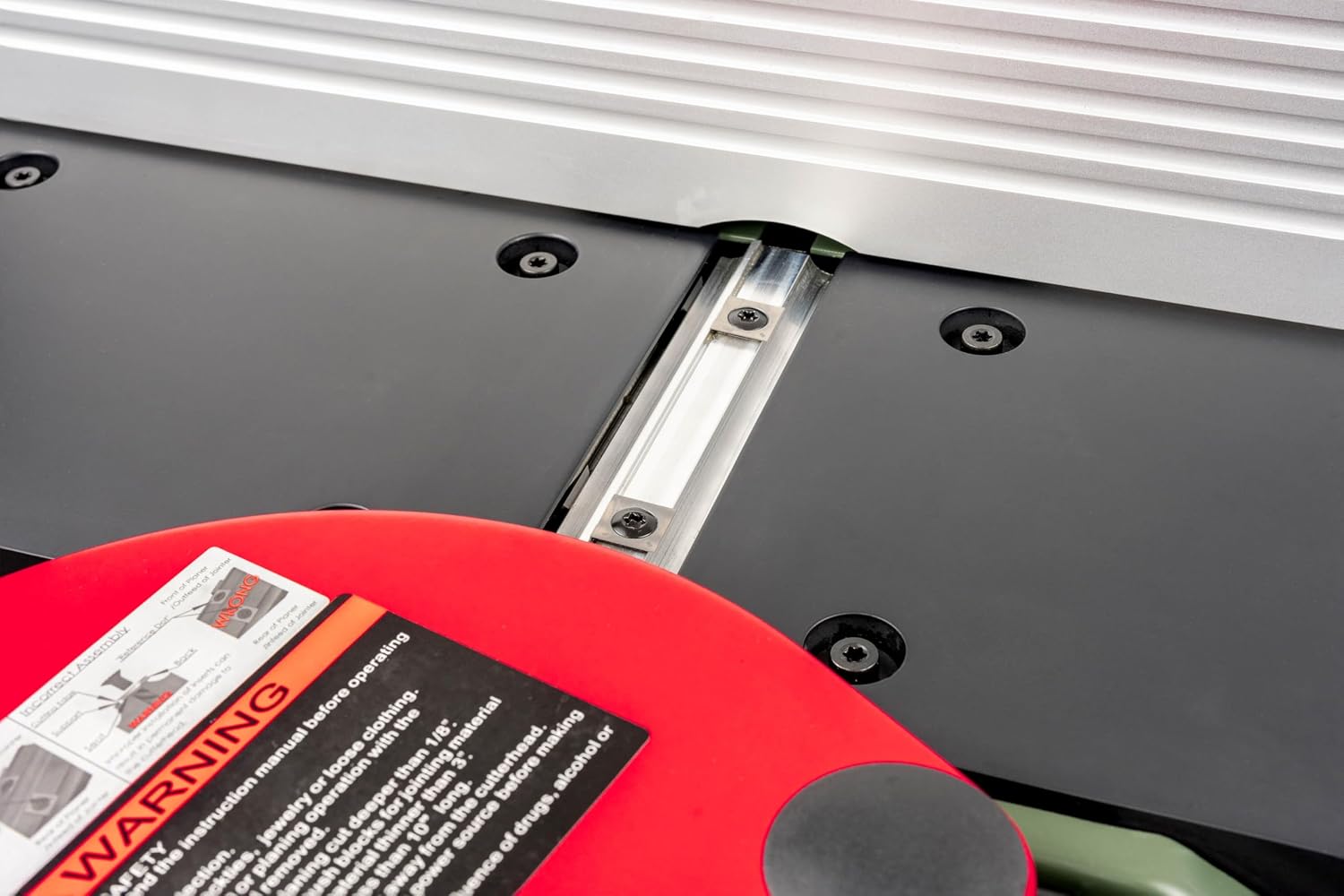
A jointer is the machine in a woodworking shop that straightens and flattens the face and edge of a rough board — it’s essentially the first step in turning lumber from the lumberyard into furniture-grade material. Most jointers come from the factory with straight high-speed steel (HSS) knives: flat, single-edged blades that span the width of the cutterhead drum. They work fine on soft, cooperative wood. But put figured maple or interlocked-grain walnut under a straight-knife head and you’ll often get tearout — little divots and lifted grain fibers that need extensive sanding to fix. A spiral cutterhead solves that problem by replacing the long straight blades with dozens of small, square carbide inserts arranged in a helical (spiral) pattern around the drum. Each insert takes a tiny, shearing cut rather than a full-width slice. The result, on most hardwoods, is a noticeably cleaner surface — and that’s where the upgrade economics start to get interesting.
If you’re sitting on a mid-range jointer — a Jet JJ-6CSDX, a Grizzly G0490, or something in that 6–8 inch class — and you’re doing any meaningful volume of hardwood work, this article will help you decide whether a spiral head retrofit or a new machine with a spiral head already installed is the smarter move for your shop.
| EDITOR'S PICK[Powermatic 6-Inch Jointer](https://www.amazon.com/dp/B001AZV2OM?tag=greenflower20-20) | Mid-tier[JET 6-Inch Benchtop Jointer](https://www.amazon.com/dp/B08JHRYMLC?tag=greenflower20-20) | Budget pick[WEN JT630H 10-Amp 6-Inch Spiral…](https://www.amazon.com/dp/B09T3X81H3?tag=greenflower20-20) | |
|---|---|---|---|
| Cutterhead type | Helical | Helical | Spiral |
| Motor power | 1 HP | 1 HP | — |
| Voltage | 115/230V | 115V | — |
| Price | $2,364.00 | $1,275.00 | $273.83 |
| See on Amazon → | See on Amazon → | See on Amazon → |
What Actually Changes When You Go Spiral
The physics matter here, so let’s be specific. A straight-knife head cuts with a long edge that contacts the full board width in a single aggressive stroke. On straight-grained softwood, that’s efficient. On hardwood with any figure, reversing grain, or interlocked structure, that same stroke lifts fibers against the grain direction — tearout.
A spiral head, also called a helical cutterhead, uses carbide insert technology borrowed from industrial metalworking. Published specs from manufacturers like Byrd Tool (maker of the widely referenced Shelix head) and Terminus Tool show insert counts ranging from 24 inserts on a 6-inch head to 60+ on an 8-inch wide model. Each insert is oriented at a slight shear angle — typically around 15 degrees — so the cut engages progressively across the board width rather than all at once. The mechanical result is lower cutting force per unit area and a slicing action that follows grain transitions more forgivingly.
Fine Woodworking’s coverage of cutterhead technology comparisons consistently notes that operators report a meaningful reduction in tearout on figured woods — particularly on species like curly maple, quartersawn white oak, and crotch-figured walnut — when moving from HSS straight knives to spiral carbide heads. Toolbox Buzz’s jointer reviews echo the same pattern: the finish off a spiral head on hardwood frequently reduces or eliminates the need for a scraper or heavy sanding pass before finishing.
There’s a second advantage that doesn’t get enough credit: noise. Straight-knife heads produce a loud, cyclical “whump” as each full-width edge engages. Spiral heads, by contrast, produce a steadier, lower-frequency hum. Shop noise levels are hard to quantify precisely without calibrated equipment, but operators in long-run reviews consistently describe the difference as substantial — particularly meaningful in shared spaces or residential garages.
The Math: Retrofit vs. New Machine
Here’s where the decision gets real. You have three paths:
Path 1: Retrofit your existing jointer — buy a Byrd Shelix or equivalent aftermarket spiral head sized for your machine and have it installed (or install it yourself if you’re comfortable with the alignment process).
Path 2: Buy a new machine that ships with a spiral head — brands like Powermatic, Laguna, and Jet now offer spiral-head configurations from the factory on their better models.
Path 3: Stay with straight knives — acceptable if your primary material is softwood or secondary hardwoods like poplar.
The cost math for a mid-2026 market looks roughly like this:
By the numbers Byrd Shelix retrofit for a 6” Jet or Grizzly jointer: ~$350–$450 (head only) Powermatic PM-JA (8”, spiral head from factory): ~$2,200–$2,600 street price Carbide insert replacement (single worn insert): ~$2–$4 per insert HSS straight knife set replacement (full set, quality aftermarket): ~$30–$60, but requires re-setting and re-jointing on each change
The cost-per-use math favors carbide inserts heavily over a long ownership cycle. Straight HSS knives on a busy shop jointer may need resharpening or replacement every 6–12 months depending on volume and material. Each knife change requires re-setting blade height with a dial indicator or setting jigs — a 30–60 minute process per set if you’re doing it carefully. Carbide inserts rotate to a fresh edge when one face dulls (each square insert has four usable edges), and full replacement of a single worn insert is a 2-minute swap with a hex key. Wood Magazine’s buyer guides consistently cite insert longevity — often 4x or more versus HSS on abrasive hardwoods — as a core justification for the carbide premium.
For someone doing one or two furniture projects a year in their garage, the retrofit ROI timeline stretches out. For someone running 15–20 board-feet of figured hardwood through the jointer weekly, the time savings on knife changes alone often justifies the retrofit cost within a year.
Which Machines Make the Most Sense
If you’re already on a decent 6- or 8-inch jointer with a cast-iron table and solid fence, a spiral head retrofit is almost always the smarter move versus buying a new entry-level machine. The table and fence quality matter more than the cutterhead to long-term accuracy — a spiral head on a jointer with a well-tuned outfeed table is a better investment than a new budget machine with a mediocre casting.
Popular Mechanics’ roundup of best jointers notes that the Powermatic PM-JA series and the Laguna Platinum jointers represent the clearest factory spiral-head value in the mid-to-upper tier, with precision-ground tables and quality fence systems that justify buying new rather than retrofitting an older chassis.
For the retrofit path, the Byrd Shelix is the most referenced aftermarket option in owner communities and long-form reviews. Terminus Tool and Lux-Cut also make compatible heads for popular platforms. The key spec to confirm before ordering is the bore diameter and overall head length — these vary by machine generation, and a misfit head is an expensive mistake. This Old House’s jointer buying guide recommends confirming these measurements against your machine’s service manual rather than assuming based on model name alone.
A few machines worth knowing by category:
Strong retrofit candidates (solid iron, worth upgrading the head):
- Jet JJ-6CSDX 6” and JJP-10BTOS 10” (popular platforms with good Shelix fitment documentation)
- Grizzly G0490 and G0856 (large user base means head compatibility is well-documented)
- Delta 37-071 (older but well-built; retrofit makes economic sense if the tables are flat)
Buy new with spiral head already installed:
- Powermatic PM-JA (8”, factory spiral, strong table quality)
- Laguna 8” Platinum Series (spiral head, long table, good fence — operators report excellent out-of-box setup)
- Jet JJ-8HH (Helical Head from factory, solid mid-tier entry point)
The Hardwood Case Is Not Universal
Be honest with yourself about your material mix. If 80% of what you’re jointing is pine, poplar, or construction-grade fir, straight HSS knives are adequate and the upgrade ROI is soft. The spiral head pays back fastest against:
- Figured hardwoods — curly, quilted, or birdseye grain patterns where tearout is almost guaranteed with straight knives
- Quartersawn lumber — ray-fleck species like white oak and sycamore where the face grain reversals are abrupt
- Reclaimed or air-dried lumber — often contains embedded grit or silica that destroys HSS edges quickly; carbide shrugs this off
- Exotic species — teak, cocobolo, and similar dense/oily hardwoods accelerate HSS wear dramatically
If your shop skews toward one of these categories, the upgrade argument is nearly airtight. Toolbox Buzz’s reviews specifically flag figured maple and quartersawn oak as the clearest use cases where operators report switching to spiral heads and not looking back.
Alignment Is Not Optional
One thing that gets glossed over in marketing copy: a spiral head is not a fix for a poorly tuned jointer. The outfeed table still needs to be coplanar with the cutterhead at the apex of rotation, the infeed table still needs to be set at the correct depth of cut, and the fence still needs to be square. A spiral head on a jointer with a 0.005” outfeed table dip will still produce snipe — just with a nicer surface texture.
Fine Woodworking’s published guidance on jointer setup emphasizes that table alignment, not cutterhead type, is the primary driver of dimensional accuracy. The spiral head improves surface quality and reduces tearout; it doesn’t compensate for mechanical slop. If your current machine has warped or pitted tables, address that first or factor a new machine into the calculus.
The Decision Rule
If you have a jointer with a quality cast-iron table in good mechanical condition and you’re processing meaningful volume of hardwood with any figure or grain reversal, retrofit a Byrd Shelix or equivalent. The blade-change time savings will recover a significant portion of the cost within the first year if you’re running the machine regularly, and the surface quality improvement on figured wood is real and consistent across owner reports.
If your current jointer has mediocre table castings, a lightweight aluminum fence, or a chassis that can’t be reliably tuned flat, buy new — and specify a factory spiral head model. The Powermatic PM-JA and Laguna 8” Platinum are the clearest values in that tier as of mid-2026.
If your material is primarily softwood or secondary hardwoods and you joint infrequently, stay with straight knives and spend the money elsewhere. The upgrade is real, but it earns its cost in direct proportion to how much figured hardwood crosses your outfeed table.
The spiral head is not hype — it’s a genuine engineering improvement with a traceable cost-benefit curve. Run the numbers against your actual shop volume, and the right answer becomes obvious.