A table saw is the workhorse of most wood shops — it’s a flat, spinning blade mounted in a table that lets you rip boards lengthwise, crosscut them to length, and make precise repeated cuts faster than almost any other tool. That speed and precision is also what makes it the most statistically dangerous power tool in the shop. According to the U.S. Consumer Product Safety Commission’s injury data, table saws account for more than 30,000 emergency room visits annually in the United States, the majority caused by a phenomenon called kickback — when the workpiece (the board you’re cutting) gets pinched against the blade and is flung back at the operator with tremendous force. The good news: the right safety accessories, used correctly, eliminate most of that risk. This article ranks them by how much real-world protection they actually deliver, with honest price context and clear recommendations based on your saw, your budget, and how you work.
Why “Safety Accessories” Isn’t a Checkbox Category
Here’s what intermediate woodworkers often get wrong: they treat safety gear as something you buy once, throw on the saw, and forget about. The reality is that different accessories address entirely different failure modes, and stacking them intelligently is what separates a safe shop from a risky one.
The three main hazard categories at the table saw are:
- Blade contact — your hand drifts into the blade
- Kickback — the workpiece is ejected toward you
- Eye and respiratory exposure — sawdust and debris at close range
Most safety products address only one of these. A push block keeps your hands away from the blade but does nothing about kickback. A riving knife (the curved piece of steel mounted just behind the blade to keep the kerf open) dramatically reduces kickback but doesn’t protect your hands. Understanding that map is the first step to building a safety stack that actually works.
The Ranking: Accessories by Actual Usefulness
1. Riving Knife or Splitter — The Single Highest-Impact Upgrade
If your saw has a fixed splitter (common on older contractor saws), upgrading to a riving knife is the most valuable safety modification you can make. A riving knife moves with the blade as you raise or lower it, maintaining its position just behind the tooth line at all times. A fixed splitter, by contrast, only works effectively at full blade height — drop the blade for a shallow cut and the splitter no longer aligns correctly.
Fine Woodworking’s table saw safety guide rates the riving knife as the single most effective kickback prevention device available on a modern table saw. The physics are straightforward: wood that has been ripped almost always wants to close around the blade as internal stresses release. Without a riving knife, that pinching creates friction, the blade catches, and the board comes back at you at blade-tip speed. With the knife in place, the kerf stays open and the board passes cleanly.
Buy this if: Your saw shipped without a riving knife (many pre-2009 contractor and hybrid saws did) or if it has a fixed splitter that you remove for dado cuts and never reinstall. Aftermarket riving knife kits are available for most major platforms — Vega, Micro Jig, and Biesemeyer all make retrofit options. Budget roughly $60–$140 for an aftermarket kit.
Skip it if: You already have a modern saw with an integrated riving knife — it came with the best version of this already installed.
2. Quality Push Blocks — Cheap Insurance With Daily Payoff
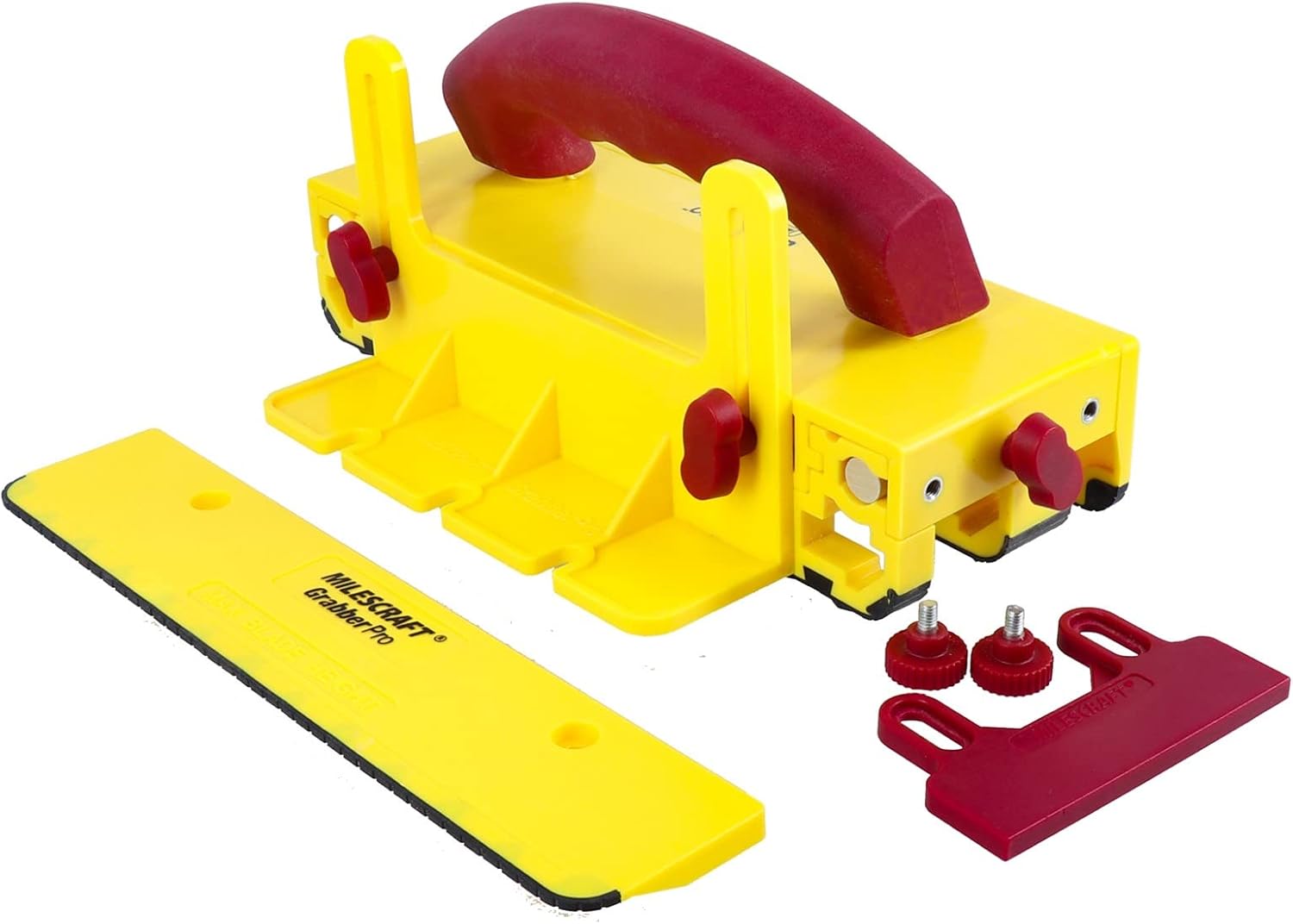
Push sticks are the safety accessory most woodworkers own and most woodworkers misuse. A thin wooden push stick keeps your hand away from the blade but offers almost no downward pressure on the workpiece — which means the board can lift, chatter, or shift at the end of the cut, right when your hand is closest to the blade.
Push blocks (the thicker, grip-style variety with a heel that hooks over the back of the board) solve this by applying simultaneous downward and forward pressure. The Micro Jig GRR-RIPPER is the most frequently cited example in this category, and for good reason: its adjustable leg system lets it straddle the fence and maintain consistent pressure through the entire cut, including the critical last few inches. Wood Magazine’s roundup of push block systems consistently highlights the GRR-RIPPER as the design that most effectively mimics what a proper hand position would do — without putting your hand anywhere near the blade.
By the numbers:
- Standard wooden push stick: ~$5–$8, addresses hand-to-blade distance only
- Micro Jig GRR-RIPPER (single): ~$35–$45, addresses hand distance + workpiece control
- GRR-RIPPER two-pack: ~$60–$75, covers most ripping scenarios
- Cost of one ER co-pay (average, 2025 U.S. data): $150–$350+
The math on spending $45 to avoid that equation is obvious.
Buy this if: You rip boards narrower than 6 inches with any regularity. That’s the zone where a standard fence-to-blade clearance leaves your hands uncomfortably close at cut completion.
Skip it if: You exclusively make wide panel cuts and already use a fence-riding push stick correctly. At 12+ inch rips, conventional push sticks handle the geometry fine.
3. A Functioning Blade Guard — Stop Removing It
This one is going to be uncomfortable for some readers: the single most common “safety upgrade” intermediate woodworkers make is removing the factory blade guard and never putting it back on. The reasoning is usually that it obscures the cut line, it’s awkward for narrow rips, or it came off for a dado stack and got left in a drawer.
This Old House’s table saw safety guide is blunt on this point — blade guards prevent a meaningful percentage of contact injuries and the visual obstruction argument largely disappears with proper fence setup and pencil line discipline. The guards that ship with mid-range and premium saws (Jet, Powermatic, SawStop) are genuinely better than the stamped-metal guards on older saws, and aftermarket options like the Excalibur Overarm Blade Guard or the Brett Guard mount above the blade and provide excellent sight lines without the awkward fence-straddling of traditional designs.
If you’ve removed your guard, the honest question is: why? If the answer is “I never put it back after a dado cut,” that’s a workflow problem, not a guard problem.
Buy this if: Your saw’s factory guard is so poorly designed you genuinely can’t use it (this is a real problem on some older contractor saws), and you want a proper overarm guard that mounts to your ceiling or a fence post. Excalibur and Brett Guard models run $200–$450 and are worth every dollar for a production shop.
4. Featherboards — Fence Consistency and Kickback Reduction
A featherboard is a shop-made or purchased fixture that presses your workpiece firmly against the fence as it moves through the cut. The angled fingers flex forward but resist backward movement, which means if a kickback starts to develop, the featherboard acts as a partial brake.
Family Handyman’s kickback prevention guide points to featherboards as a particularly high-value accessory for stock under 1 inch thick — thin material is most prone to deflecting away from the fence mid-cut, and that deflection is a common kickback precursor.
Magnetic featherboards (the Kreg model is the most widely reviewed) attach to cast iron table tops without clamps and adjust in seconds. Owners in aggregated reviews consistently note that the setup time drops to under 30 seconds once you’ve used one a few times, removing the common excuse of “too much hassle for a short run.”
Buy this if: You regularly run thin stock (under ¾ inch) or long boards solo. Two featherboards — one at the fence, one on the table — is the standard production setup.
Skip it if: You’re running sheet goods or wide panels where the mass of the workpiece makes deflection unlikely.
5. SawStop or Equivalent Active Injury Mitigation — For High-Stakes Shops
This is the category that separates a conversation about accessories from a conversation about saw selection, but it belongs here because it’s increasingly a retrofit consideration, not just a new-purchase decision.
SawStop’s flesh-detection technology (the saw detects electrical conductivity change when the blade contacts skin and stops within milliseconds) has a published injury prevention record that no passive accessory category can match. Popular Mechanics’ coverage of SawStop’s commercial track record notes the system has logged over 10,000 documented activations without a serious amputation — a statistic no push block or riving knife can claim.
The tradeoff is real: a SawStop Professional Cabinet Saw runs $3,500–$5,000+, and a brake cartridge replacement after an activation costs roughly $70–$90. For a serious craftsperson or small-shop professional, that’s a capital expenditure decision, not an accessories purchase. But if you’re speccing a new cabinet saw and the SawStop is within range, the long-term cost-of-ownership math — factoring in avoided injury, insurance exposure, and lost work time — routinely favors the premium.
The Practical Safety Stack, by Shop Tier
| Shop Tier | Non-Negotiable | Worth Adding | Skip For Now |
|---|---|---|---|
| Weekend DIY ($150–$500 saw) | Push block, riving knife check | Featherboard | Overarm guard (cost exceeds saw value) |
| Intermediate ($800–$2,500 saw) | GRR-RIPPER, riving knife, featherboards | Overarm blade guard | SawStop retrofit (not available) |
| Serious / Pro ($3,500+ saw) | All of the above + SawStop consideration at next saw purchase | Excalibur overarm guard | Nothing — this stack is complete |
Clear Decision Rules
If you rip stock narrower than 6 inches more than once a week: Buy the Micro Jig GRR-RIPPER before any other accessory. The hand-proximity risk at narrow rips is the most common injury scenario at the table saw for intermediate woodworkers, and $40 fixes it completely.
If your saw has a fixed splitter and you remove it for dado cuts: Either add an aftermarket riving knife kit or make a strict rule that the splitter goes back on after every dado operation. The kickback risk on a saw running without any splitter is significantly higher than most users appreciate until they read the failure-mode literature.
If you’re buying a new cabinet saw and the SawStop Professional Cabinet Saw is within $800 of your next-best option: The active brake technology is worth the delta. It’s not marketing — it’s a documented, physics-based injury prevention system with a track record that passive accessories cannot replicate.
If your blade guard is in a drawer: Put it back on today. The visibility argument is the most commonly cited and least defensible reason to run a table saw uncovered.
The accessories in this ranking cost less combined than a single ER visit. The decision framework isn’t complicated — it’s just a matter of treating shop safety with the same rigor you’d apply to any other tool investment.