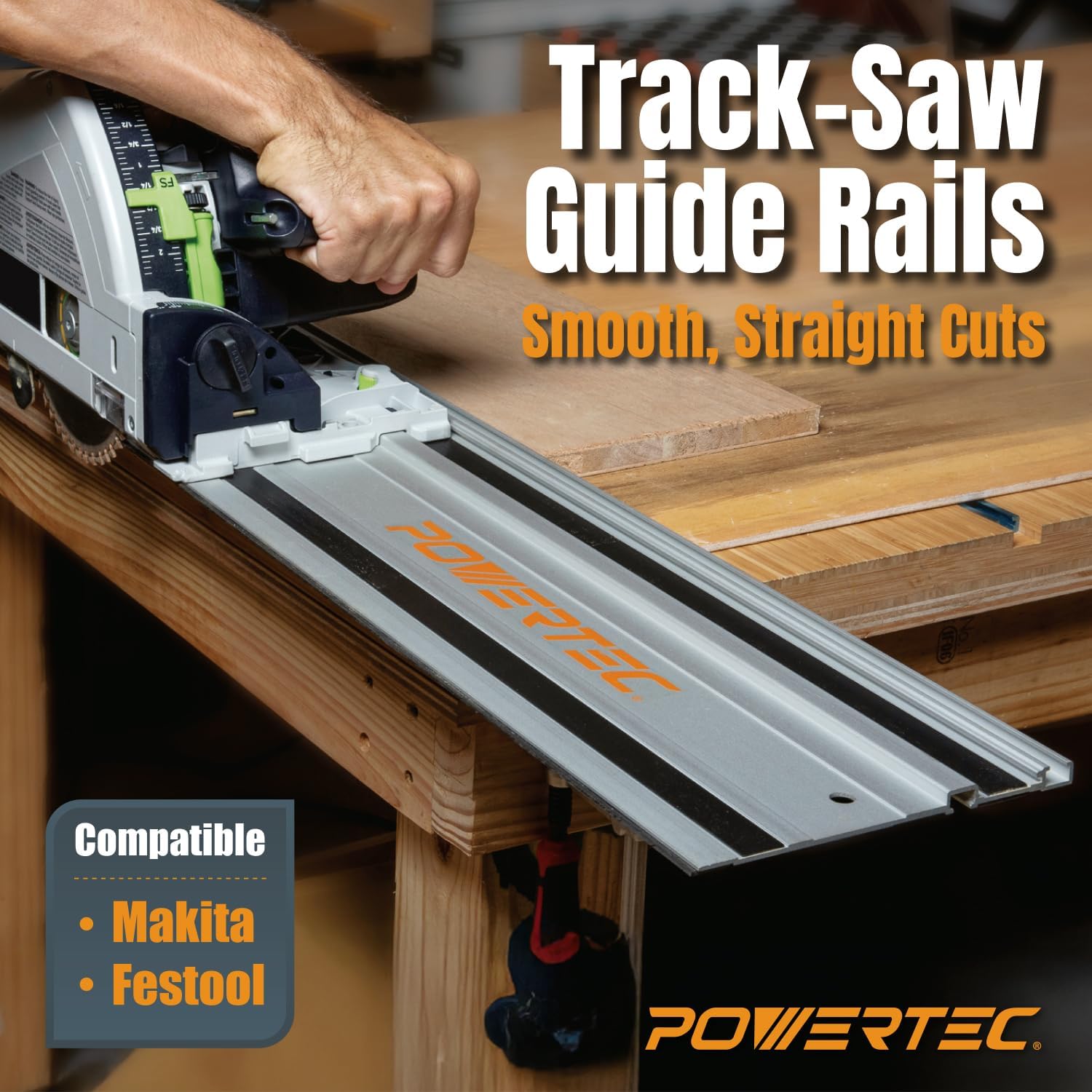
A track saw — sometimes called a plunge-cut saw — is a circular saw that rides along a dedicated aluminum guide rail, delivering dead-straight cuts with almost no tearout on the top face of the material. Unlike a table saw, which requires you to move the wood through the blade, a track saw moves the tool along the wood. That makes it the go-to solution for breaking down large sheet goods (plywood, MDF, melamine) on a jobsite or in a small shop where you don’t have room for a full-size cabinet saw. If you’ve just bought your first track saw — or you’re evaluating the ecosystem before committing to a brand — this guide is for you. We’ll cover which accessories genuinely expand what the tool can do, which ones are marketing fluff, and how to make the rail system you already own work harder.
The short version: the saw is the least important purchasing decision once you’re past entry level. The rails, clamps, connectors, and stop systems around it are what determine whether your workflow is fluid or frustrating. Here’s how to think through each piece.
| EDITOR'S PICK[Festool 495315 Multifunction Ta](https://www.amazon.com/dp/B00AT2S6E6?tag=greenflower20-20)… | Mid-tier[Kreg KMA2700 Accu-Cut - Univers](https://www.amazon.com/dp/B073PGP96S?tag=greenflower20-20)… | Budget pick[WEN CT992F 7.5-Inch Quick Relea](https://www.amazon.com/dp/B07VDTQ212?tag=greenflower20-20)… | |
|---|---|---|---|
| Type | Multifunction table | Track saw guide system | Clamps |
| Max cut length | — | 50" | — |
| Clamps included | — | No | Yes |
| Clamp size | — | — | 7.5" |
| Quantity | — | — | 2 pack |
| Clamp type | — | — | Quick release |
| Price | $849.00 | $88.00 | $20.35 |
| See on Amazon → | See on Amazon → | See on Amazon → |
The Guide Rail Is the Product — Treat It That Way
Most buyers fixate on the saw spec sheet and treat the rail as an afterthought. That’s backwards. The rail determines cut quality, repeatability, and long-term versatility more than the motor does once you’re comparing competent saws in the same class.
Rail material and profile matter. Festool’s FS guide rails — the standard against which everything else is benchmarked, per Fine Woodworking’s track saw buyer’s guide — use a hard-anodized aluminum extrusion with a factory-applied anti-splinter strip (a compressible rubber edge that contacts the workpiece, virtually eliminating tearout). Makita’s guide rails follow a similar profile and are reasonably close in rigidity. DeWalt’s rails are slightly lighter and work well within the DeWalt ecosystem but have attracted criticism in long-run reviews for flex on rails longer than 1,400 mm. Owners on contractor forums consistently report that the DeWalt flex issue only manifests under aggressive feed rates — light, controlled passes are fine — but it’s a real limitation if you’re ripping 8-foot sheet goods in a single continuous stroke.
Rail length planning. This is where most buyers under-invest on the first purchase. A 1,400 mm (55-inch) rail handles a single 4×8 sheet rip cut in one pass — just. A 1,900 mm (75-inch) rail gives you that same cut with margin for square starts and stops. The math here is unforgiving:
By the numbers Standard 4×8 plywood sheet diagonal: ~116 inches (2,946 mm) Max single-pass cut with 1,400 mm rail: ~55 inches — enough for an 8-foot rip, nothing more Recommended starter rail length: 1,900 mm for sheet goods; 800 mm or 1,080 mm as a second short rail for trim and panel work Rail connector set adds ~$40–$80 and effectively gives you one continuous rail up to 3,000 mm+ when paired
If you’re sizing a first system, buy the 1,900 mm rail before the short one. The short rail is genuinely useful — especially for crosscuts, stair tread work, and miter cuts on narrow stock — but it’s the second purchase, not the first.
Clamps: The Piece Almost Everyone Gets Wrong
Standard F-style bar clamps — the kind you probably have hanging on your shop wall — will hold a rail in place, but they create a real problem: the clamp body sits above the rail surface and can physically obstruct the saw’s base plate path. This is a workflow-killer on long rips.
Rail-specific clamps are not optional. Festool’s FS-Rapid clamps (compatible with Festool FS rails) sit below the rail surface, clamping from the side. They’re slim enough that the saw passes over them without contact. Makita’s equivalent clamps follow the same profile. The price delta versus improvising with hardware-store clamps is typically $15–$30 per clamp — completely worth it once you’ve had a saw jump a rail mid-cut because a clamp body got in the way.
How many clamps do you actually need? For a 1,900 mm rail, two clamps is the working minimum; three is the right answer for any cut longer than 4 feet where the workpiece is less than ¾-inch thick and prone to flex. The center clamp prevents rail lift if your work surface isn’t perfectly flat — and on sawhorses or a foam-sheet cutting surface, it rarely is.
Clamping to the workpiece vs. the bench. One under-discussed decision: are you clamping the rail to the workpiece directly, or securing both the workpiece and rail to an underlying bench or MFT-style (multi-function table) surface? If you’re cutting sheet goods on a foam sacrificial base on the floor, direct-clamp to the workpiece is your only option. If you’re working on an MFT table with dog-hole patterns, rail dogs (small positioning pegs that drop into the holes and register against the rail’s edge) can replace clamps entirely on rough-positioning passes, then you clamp for final cuts. Toolbox Buzz’s review of the Festool MFT/3 table notes that the rail-dog system is one of the genuinely time-saving innovations for production repetition work — it’s not a gimmick.
Connectors, Stops, and Parallel Guides: The Accessories That Pay Off
Rail Connectors
If you own a 1,900 mm and an 800 mm rail, a connector set turns them into a 2,700 mm rail — long enough for full diagonal cuts on a 4×8 sheet. The connector is a small aluminum bridge piece with set screws that aligns the two rail ends and locks them coplanar. Quality matters here: a poorly made connector allows a slight vertical step between rail sections, which the saw’s base plate will catch and deflect off of. Festool’s own connectors hold zero step reliably. Third-party connectors compatible with Festool rails are available at lower cost, but reviewers at Pro Tool Reviews note that the fit tolerance on off-brand connectors varies batch-to-batch. For a $40–$60 component that lives at the critical junction of your longest cuts, buy first-party.
Parallel Guides
A parallel guide mounts to the rail and uses a fence that runs against the edge of your workpiece, allowing you to make consistent-width rip cuts without measuring and marking every time. This is the single most underrated accessory in the track saw ecosystem. If you’re building cabinet carcasses, cutting drawer parts, or ripping consistent stile-and-rail stock, a parallel guide turns a two-step (mark, then cut) operation into a one-step operation.
Festool’s LR 32 system takes this further: it’s a precision hole-drilling guide that uses the same rails to bore 32 mm-spaced shelf pin holes — the European cabinet-making standard. If you’re doing any production case work, this accessory alone can justify the Festool ecosystem premium over competing systems. Fine Woodworking has covered the LR 32 system in multiple issues and consistently positions it as the workflow differentiator for furniture makers who’ve already bought into the Festool rail platform.
Stop Blocks
A stop block clamps onto the rail at a set position and gives the saw’s base plate a hard stop for repetitive crosscuts to a consistent length. For one-off cuts, this is unnecessary. For cutting 20 shelf parts to identical length, it’s faster and more accurate than any pencil mark. The Festool FS stop is the reference product; Makita and DeWalt both offer compatible stops for their respective rail systems. Aftermarket options from manufacturers like Woodpeckers are available at higher price points for users who want precision adjustment in thousandths rather than visual alignment.
Cross-Brand Compatibility: The Decision That Locks You In
Here’s the tradeoff you need to name explicitly before you buy your second accessory: track saw ecosystems are mostly not cross-compatible at the accessory level, and that matters at purchase three, not purchase one.
The Festool FS rail profile is the de facto industry standard. Mafell track saws run on Festool rails. Several third-party accessory makers (Woodpeckers, Seneca, others) specifically engineer their stops and guides for the Festool FS profile. If you buy a Makita or DeWalt saw and later want to expand into a more accessory-rich ecosystem, you’re either adapting with third-party solutions or starting over on rails.
This doesn’t mean you should default to Festool. Popular Mechanics’ 2025 track saw review notes that the Makita SP6000J1 delivers cut quality very close to the Festool TS 55 REQ at roughly half the system cost, and Makita’s accessory line covers the core use cases — clamps, connectors, parallel guide — competently. The gap shows up in the specialty accessories (LR 32, MFT integration, Systainer dust management) that matter for a high-production shop but are irrelevant to a general-purpose garage setup.
The decision rule:
- If your primary use is breaking down sheet goods for cabinet or furniture work, and you run any other Festool tools (sanders, routers, dust extractor), commit to the Festool FS ecosystem. The accessory depth and resale value of Festool rails hold up better than any competing system.
- If you’re a contractor or remodeler who needs a track saw for occasional precise site cuts and your shop is already Makita or DeWalt cordless, buy that brand’s track saw and the three core accessories (clamps, connector, parallel guide). Don’t over-invest in ecosystem depth you won’t use.
- If you’re buying your first track saw under $500 and aren’t sure yet how heavily you’ll rely on it, start with a Makita 55-inch kit (saw + rail), add two clamps, and defer every other accessory decision until you understand your actual workflow. The worst outcome is buying a Festool accessory stack before you know whether you need it.
What to Skip (At Least for Now)
Dust port adapters beyond your extractor’s native hose: The track saw’s dust collection is already excellent — This Old House’s track saw guide cites over 90% dust capture as typical for rail saws paired with a shop vac or dedicated extractor. Third-party “universal” dust adapters frequently leak around the connection and reduce suction. If your saw’s native hose fits your extractor, use it.
Rail bags and cases: Nice to have for jobsite transport. Not a shop priority. A few pieces of foam in a shelf bin works identically.
Splinter guards beyond the factory strip: The factory anti-splinter strip on a quality rail does the job. Aftermarket adhesive-backed replacements are a maintenance item, not an upgrade.
The track saw ecosystem rewards deliberate, sequential investment. Buy the right rail length first, add clamps before anything else, add a parallel guide once you’re cutting repetitive parts, and defer specialty accessories until a specific workflow bottleneck makes them obviously worth it. That sequence holds regardless of which brand you commit to.